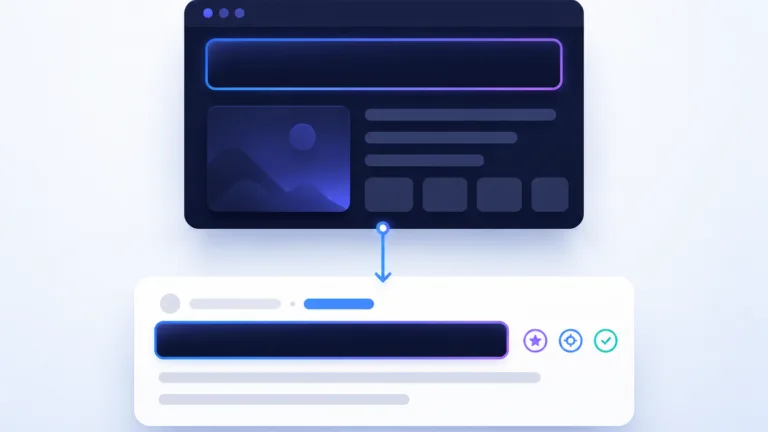
The is the short descriptive text that often appears below the in Google. It does not directly determine your ranking. But it influences whether someone clicks your search result or scrolls past it.
That makes the meta description one of the most underestimated levers in search engine optimization: it costs nothing, can be adjusted quickly and can significantly improve — especially for pages that already receive but generate too few clicks.
In this article, you will learn what a meta description is, how long it should be, how to write strong descriptions and which mistakes to avoid.
- The meta description is not a direct ranking factor.
- However, it influences the click-through rate of the .
- A practical guideline is usually approx. 120 to 160 characters; there is no fixed Google limit.
- The most important information should appear in the first 100 to 120 characters.
- Every important page should have its own relevant meta description.
- Google may rewrite the meta description if another text excerpt better matches the .
What Is a Meta Description? #
The meta description is a short descriptive text stored in the code of a page. It appears in the <head> section of the website and can be used by Google as the description in the search result.
Google describes snippets as short text excerpts that help users understand a result before clicking. The meta description can be used for this when it summarizes the page content precisely and relevantly. However, Google also points out that automatically generated snippets from the visible page content may be used if they better match the search query.
Source: Google Search Central – Control your snippets
Technically, a meta description looks like this:
<meta name="description" content="This is the page description. It briefly explains what the page is about and why users should click.">For visitors, this text is normally not visible on the web page itself. It mainly becomes visible when Google displays it as part of the search result.
A Google snippet usually consists of:
- the page title,
- the URL or structure,
- the description.
The meta description is therefore something like the ad copy for your page in Google.
Why Is the Meta Description Important? #
Even though the meta description is not a direct ranking factor, it has a clear impact on the performance of your page in search.
The reason: on the , your result competes with many other results. Users decide within a few seconds which result seems most relevant.
A good meta description helps answer three questions immediately:
- What is this page about?
- Does the result match my search query?
- Why should I click this specific result?
Especially for guides, landing pages, product categories and important service pages, a good meta description can make a noticeable difference.
Google itself recommends using meaningful, individual descriptions for relevant pages so that snippets become more helpful for users.
Source: Google Search Central – Best practices for meta descriptions
Meta Description Length: How Long Should It Be? #
A good rule of thumb for meta description length is:
approx. 120 to 160 characters as a practical guideline — not a fixed Google limit
This recommendation also appears in many guidelines, for example from SISTRIX. But the key point is this: Google does not strictly measure snippets by character count. Instead, it truncates them depending on the available space in the search result. The available width depends on factors such as device, layout and the characters used.
SISTRIX therefore recommends thinking not only in characters but also in pixels. Wide letters like “W” take up more space than narrow letters like “i”. As a result, one description with 155 characters may be displayed fully, while another with the same character count may already be truncated.
Source: SISTRIX – Meta Description
As a guide:
| Range | Recommendation |
|---|---|
| Very short | under 80 characters, often not informative enough |
| Good practical range | approx. 120 to 160 characters |
| Risk of truncation | from approx. 160 characters |
| Especially important on mobile | core message in the first 100 to 120 characters |
The best solution is therefore not to write rigidly toward 160 characters. It is better to structure the description so that the most important part remains understandable even if Google truncates it.
Example of a Good Meta Description #
A good meta description is specific, easy to understand and makes the value of the page clear.
Example for this article:
The meta description is your free ad copy in Google. Learn how to write descriptions that earn clicks — with ideal length, examples and templates.
This description works because it:
- mentions the main keyword early,
- makes the benefit clear,
- covers relevant secondary keywords,
- is easy to understand,
- sets a concrete expectation for the content.
Bad Meta Description Examples #
Many meta descriptions waste potential because they are too generic, too long or overloaded with keywords.
Example 1: Too Generic #
Welcome to our website. Here you will find lots of information about our services and offers.
Problem: The text says nothing specific. Users do not understand why they should click.
Example 2: Keyword Stuffing #
Meta description, meta description length, meta description example, write meta description, Google snippet.
Problem: The text feels unnatural and provides no real value.
Example 3: Too Long and Unclear #
In this very detailed article, we explain exactly everything you need to know about meta descriptions, how to write them, why they are important and what benefits they can have for your search engine optimization.
Problem: The statement is too long, too nested and will probably be cut off.
How to Write a Good Meta Description #
Writing a meta description is not about squeezing in as many keywords as possible. What matters is that search intent, value and page content fit together.
A simple structure works in many cases:
Keyword + benefit + specification + action impulse
Example:
Write a meta description: Learn which length is ideal, which mistakes to avoid and what strong Google snippets look like.
This structure is especially useful for guides and informational pages.
For commercial pages, the structure can be slightly more sales-oriented:
Individual SEO consulting for small and medium-sized businesses (SMEs): We analyze your website, identify concrete opportunities and prioritize the next steps.
7 Rules for Better Meta Descriptions #
1. Mention the Main Keyword Early #
The focus keyword should appear as close to the beginning as possible. For this article, that is meta description. This helps users immediately recognize that the page matches their search query.
2. Match Search Intent #
Someone searching for “meta description example” expects concrete examples. Someone searching for “meta description length” wants a clear recommendation. The description should reflect that expectation.
3. Provide Value Instead of Just Describing #
Do not only explain what the page is about. Show what the user gets from it.
Weak:
Information about the meta description and its importance for SEO.
Better:
Learn how to write meta descriptions that stand out in Google and bring more clicks to your page.
4. Stay Specific #
Specific statements are stronger than generic promises.
Instead of:
Many helpful tips for better snippets.
Better:
With ideal length, examples, templates and common mistakes.
5. Do Not Make False Promises #
The description must match the page content. If the snippet promises a free download, that download must also be visibly available on the page.
6. Describe Every Important Page Individually #
Duplicate meta descriptions are a common problem. They often occur on large websites, category pages or product pages.
Important pages should always have their own meta descriptions.
7. Consider the Risk of Truncation #
Write so that the core message appears at the beginning. If Google cuts off the end, the snippet should still remain understandable.
Why Google Sometimes Does Not Show Your Meta Description #
Google does not always use the stored meta description. In its documentation, Google essentially says that it uses the description tag when it provides users with a more suitable description than an automatically selected excerpt from the page content.
This means: the meta description is a recommendation to Google, not a guarantee.
This happens especially when:
- the search query does not match the meta description well,
- the description is too generic,
- the description is missing,
- several pages use the same description,
- a text excerpt on the page better matches the specific search query.
Studies also show that Google frequently rewrites meta descriptions. Portent analyzed search results and found that Google does not use the stored meta description for a large share of results. Search Engine Journal summarized the same study with rewrite rates of around 68% on desktop and 71% on mobile.
Sources: Portent – How Often Google Ignores Our Meta Descriptions, Search Engine Journal – Google Rewrites Meta Descriptions Over 70% Of The Time
This is not automatically a mistake. Google tries to display the most relevant excerpt for each search query. Nevertheless, a good meta description is worthwhile. It gives Google a clear recommendation and improves the chance that your desired text will be used.
Meta Descriptions in WordPress, Craft CMS and Other Systems #
In most content management systems (), systems used to manage website content, the meta description is maintained through an SEO field.
Meta Description in WordPress #
In WordPress, the meta description is usually entered through an SEO plugin such as Yoast SEO, Rank Math or The SEO Framework. For each page or post, you will typically find a field for the SEO title and meta description.
Important: the description should not simply be taken automatically from the first paragraph. For important pages, manual optimization is worthwhile.
Meta Description in Craft CMS #
In Craft CMS, maintenance depends on the setup. Often there is a dedicated SEO field or an SEO plugin. What matters is that each entry outputs an individual description and that no empty or duplicate values are created.
Meta Descriptions in Online Shops #
For shops with many products and categories, purely manual maintenance is often unrealistic. Templates can help here.
Example for a product category:
Discover {{ category.title }} online: wide selection, fast delivery and personal advice. Find suitable products now.
Such templates are helpful, but they should not be too generic. For important categories and top products, manually optimized descriptions are usually better.
Meta Description Templates #
You can use these templates as a starting point.
Template for Guide Articles #
[Topic] explained simply: Learn what matters, which mistakes to avoid and how to proceed step by step.
Example:
Meta descriptions explained simply: Learn which length is ideal, which mistakes to avoid and how to write better snippets.
Template for Service Pages #
[Service] for [target audience]: We help you with [problem/benefit] — with clear analysis, concrete recommendations and pragmatic implementation.
Example:
SEO consulting for SMEs: We analyze your website, prioritize opportunities and show concrete next steps for more visibility.
Template for Product Categories #
Buy [product category] online: Discover [selection/benefit], benefit from [USP] and find the right product for [need].
Example:
Buy hiking boots online: Discover robust models for every terrain, with fast delivery and expert advice.
Template for Local Pages #
[Service] in [location]: Personal advice, clear recommendations and implementation from a single source. Learn more now.
Example:
SEO consulting in Lucerne: We analyze your website, identify opportunities and support you during implementation.
Common Meta Description Mistakes #
Missing Meta Description #
If no description is provided, Google automatically creates a snippet from the page content. This can work, but it often feels less precise. Google itself recommends providing meaningful meta descriptions for relevant pages.
Source: Google Search Central – Control your snippets
Duplicate Meta Descriptions #
If many pages use the same description, clear differentiation is missing. This is especially problematic for categories, location pages or blog posts.
Description Too Long #
If the description is truncated, the most important message may be lost. That is why the central benefit should appear at the beginning. SISTRIX points out that snippets may be cut off when the pixel width is too large.
Source: SISTRIX – Meta Description
Description Too Short #
Very short descriptions waste space and often provide too little context. A good meta description should briefly summarize the page content and also encourage the click.
No Link to Search Intent #
A description can be formally correct and still perform poorly if it does not match the . In such cases, Google may choose a different excerpt from the page content.
Too Promotional or Exaggerated #
Wording such as “the best solution ever” quickly feels untrustworthy. Concrete value arguments that match the page are better.
How to Prioritize Missing Meta Descriptions #
For small websites, you can add missing meta descriptions directly to all important pages. For larger websites, you should prioritize.
Start with pages that:
- have many impressions in Google ,
- already rank in positions 1 to 20,
- have a below-average click-through rate,
- are important for revenue, leads or inquiries,
- are used as landing pages in campaigns.
Not every unimportant archive page immediately needs a perfectly written description. The first priority is pages with real potential.
Measuring Success: Does the New Meta Description Bring More Clicks? #
The best way to check whether an optimized meta description works is in Google Search Console.
Proceed as follows:
- Open the performance report.
- Filter by the optimized page.
- Compare impressions, clicks, click-through rate (CTR), meaning the click rate in the search result, and position before and after the change.
- Make sure the average position has remained similar.
- Also check directly in Google which snippet is actually displayed.
Important: individual days are not very meaningful. A comparison over several weeks is better, provided there are enough impressions.
If the position remains similar but CTR increases, that is a good sign that your snippet is working better.
Meta Descriptions and AI Search #
Even in a search environment increasingly shaped by artificial intelligence (AI) answers, and summarized results, clear metadata remains important.
The meta description is not the only or most important factor. Google still describes snippets as short summaries that help users understand a result. For AI systems, the visible page content, headings, structured information and the general trustworthiness of a source are also important.
Source: Google Search Central – Control your snippets
Nevertheless, a good meta description helps classify the content of a page clearly. It should therefore not be viewed in isolation, but should align with the , the page title and the introductory text.
Good alignment means:
- The title describes the main topic.
- The H1 confirms the topic.
- The introduction answers the search intent.
- The meta description summarizes the value precisely.
This creates a consistent signal for users, search engines and AI systems.
Checklist: Writing a Good Meta Description #
Use this checklist before publishing:
- Does the description contain the focus keyword?
- Is the most important statement placed at the beginning?
- Does the text match the search intent?
- Is a clear benefit communicated?
- Is the length roughly in the range of 120 to 160 characters?
- Is the description unique?
- Does it avoid keyword stuffing?
- Does it avoid false promises?
- Does it fit the title, H1 and page content?
- Would I click this result myself?
In addition, title tags and content updates help narrow down the cause and prioritize the next SEO measures.
FAQ (Frequently Asked Questions) About Meta Descriptions #
What Is a Meta Description?
A meta description is a short descriptive text in the HTML code of a web page. Search engines can display it as the description in the search result.
How Long Should a Meta Description Be?
A practical guideline is approx. 120 to 160 characters. However, there is no fixed Google limit: snippets are truncated differently depending on search query, device and layout. The most important statement should therefore appear within the first 100 to 120 characters.
Is the Meta Description a Ranking Factor?
No, the meta description is not a direct ranking factor. However, it can influence click-through rate and thereby improve the organic performance of a page.
Why Does Google Not Show My Meta Description?
Google can create its own snippet from the page content if that excerpt better matches the search query or if the stored description is too generic, duplicated or unsuitable.
Does Every Page Need a Meta Description?
Every important indexable page should have its own meta description. It is especially important for pages with organic potential, commercial relevance or many impressions.
How Do I Write a Good Meta Description?
Mention the main keyword early, address the search intent, communicate a clear benefit and stay specific. The description should be unique and match the content of the page.
What Is a Good Meta Description Example?
A good example is: “Meta descriptions explained simply: Learn which length is ideal, which mistakes to avoid and how to write better snippets.”
Conclusion: A Small Adjustment With a Big Effect #
The meta description is not a ranking booster in the traditional sense. But it is an important lever for better Google snippets and more clicks from existing rankings.
Optimization is especially worthwhile for pages with many impressions and a weak CTR. Write clearly, specifically and with the user in mind. Mention the main keyword early, show the benefit and keep the description unique.
When title, H1, introduction and meta description work together cleanly, your page becomes easier for users to understand — and your search result becomes significantly more attractive.