Online search is going through its biggest transformation since the invention of the search engine. You open a browser, type a question and immediately get a synthesised, ready-made answer from chatbots or . The consequence: a large share of searches now end without a single click to a traditional website. For website operators and marketers this is a fundamental shift. When users consume the information directly inside the AI answer, ranking on page 1 is no longer enough — your brand has to be cited in the AI answer.
Many websites are technically clean and full of excellent content, yet they stay invisible. The reason often isn't on your own page — it's a lack of external . Algorithms and (LLMs) need evidence from the rest of the web to consider a brand credible. The old mantra "we just need more backlinks" falls short in 2026. Today it's about a holistic off-page strategy: unlinked brand mentions, consistent business data, in-depth online reviews and digital PR.
In this article you'll learn how off-page optimisation — and with it Generative Engine Optimization () — has changed in 2026, which signals AI systems and search engines really use, and how to build measurable authority as a company.
- Off-page signals are trust and from outside your own website.
- This insight is not a backlink scan: it is triggered by low visibility in search or AI, not by a direct off-page measurement.
- Concretely, it appears when a topic's or score (EAP) drops below a threshold.
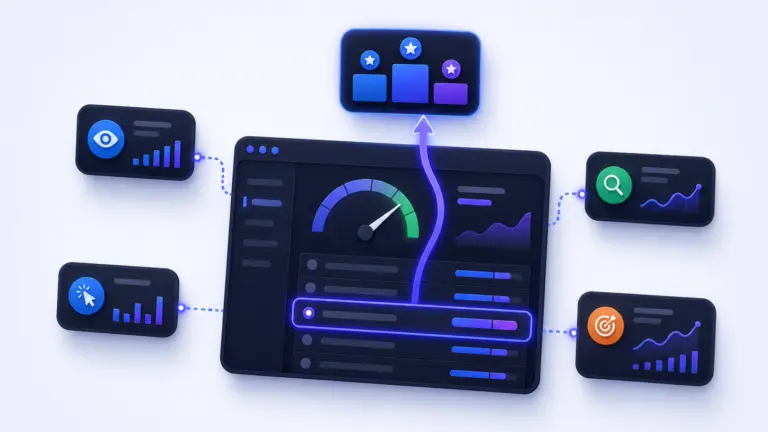
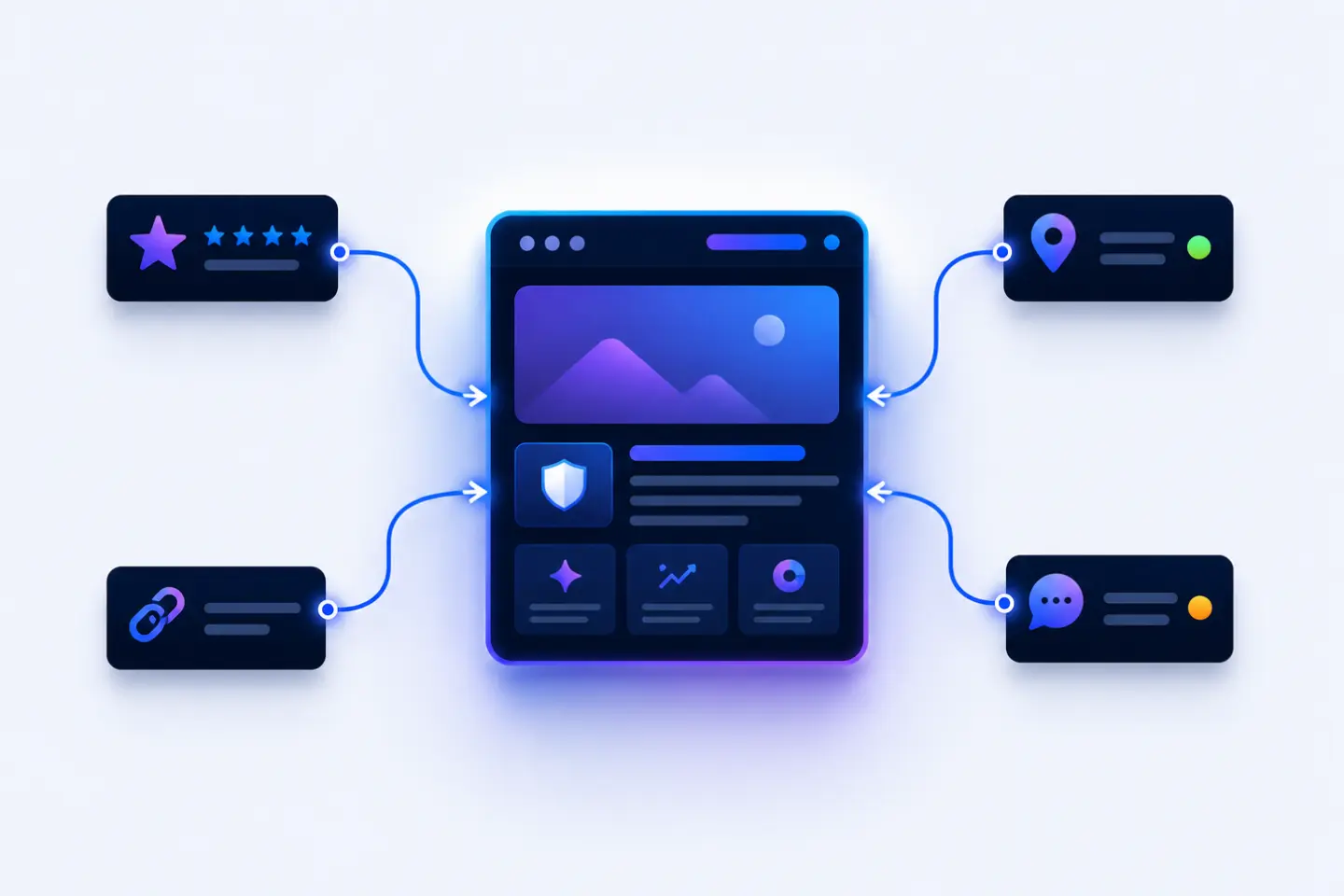
- The key levers: reviews, directory listings / citations, backlinks and digital PR, and brand mentions.
- Off-page signals affect Google and AI at the same time, because both look for authority and established sources.
- Off-page doesn't replace on-page fundamentals — it amplifies them.
- Quality and relevance beat volume. Bought links and fake reviews do more harm than good.
- Building off-page authority is medium- to long-term work without a guarantee, but with a clear direction.
From Classic Link Building to Entity Signals: The New Off-Page Reality #
Traditionally, off-page covered every measure outside your own domain aimed at improving search rankings. For over a decade, PageRank — the sheer number and strength of backlinks — was the undisputed main currency. But the weighting has shifted. Backlinks remain an important part of Google's algorithm and are essential just to reach top rankings, yet different rules apply to visibility in AI answers.
Generative AI models don't read the web as a pure link hierarchy but as a network of (people, brands, places, concepts). At the heart of GEO is so-called "entity clarity": how clearly can the AI recognise your brand and assign it to a specific field? Search systems read external signals as confirmation of your , and so they assess your E-E-A-T and trust signals (Experience, Expertise, Authoritativeness, Trustworthiness).
A large-scale 2026 study by Ahrefs, analysing around 75,000 brands, offers data-backed proof of this shift: the classic "Domain Authority" metric explains only a small fraction of the variance in AI citations. Instead, brand mentions on YouTube and general unlinked brand mentions on the web show by far the strongest relationships with AI visibility.
The golden rule for 2026: mentioning your brand in the right context is the actual signal; the clickable link is often just decoration.
Why Off-Page Signals Matter for Google and AI #
Both classic search engines and LLMs face the same problem: from a of content increasingly flooded with generative AI, they have to filter out the most reliable sources. To avoid hallucinations and misinformation, the models stay strongly risk-averse.
LLMs don't create their own authority — they merely aggregate it. If your brand isn't discussed consistently and positively on trusted third-party platforms, you simply won't show up in the AI's synthesised consensus. User behaviour has long adapted in parallel:
- A large share of B2B buyers now start their research with an AI assistant before visiting a vendor's website.
- Clicks are declining: organic click-through rates on the first Google position drop noticeably when an is shown.
- Citation drives traffic: if your brand is named as a source within the AI answer and linked, click-through rates rise versus non-cited competitors — and that traffic is highly pre-qualified.
To counter the causes of declining rankings and shrinking traffic, there's no way around adapting your off-page strategy.
| Aspect | Classic link building (focus until 2024) | Modern GEO & off-page (focus 2026) |
|---|---|---|
| Main metric | Domain Authority & link volume | Citation frequency & brand mentions |
| Focus | in | Context, & entity relationships |
| Trust source | PageRank (links) | Cross-platform consensus & reviews |
| Objective | Position 1 on the (10 blue links) | Recommendation within the AI answer (shortlist) |
Five Core Strategies for Building Off-Page Authority #
To be favoured by Google and cited by AI systems in 2026, you need to move your focus from technical metrics to genuine trust-building. The following five levers are decisive.
1. Unlinked Brand Mentions as the Primary Signal #
LLMs see the entire internet as a giant network of information. If your brand is regularly mentioned in high-quality articles, forums or reviews in the context of your field, the AI model learns that association — even without a clickable hyperlink. How to deliberately drive these mentions and citations is a topic of its own.
- Community platforms dominate: forums have become a central information source for AI systems, contributing a substantial share of citations across the major models.
- User-generated content (UGC): several AI models weight user-generated content and earned media noticeably higher than other sources.
- Implementation: become an authentic part of professional communities. Genuine community engagement (without promotional spamming) is essential. Brands mentioned positively on several independent platforms have a clearly higher chance of being cited by AI systems.
2. Digital PR and Original Research (Proprietary Data) #
AI systems are trained to reproduce safe, verifiable facts. Generic summaries of already-known topics add no value and are rarely cited.
- Facts and statistics: the GEO framework developed by researchers (Princeton, Georgia Tech) shows that integrating your own, verifiable statistics into content measurably increases AI visibility — it's one of the most effective levers there is.
- Earned media: a large share of AI citations comes from "earned media" (earned coverage) rather than companies' own websites.
- Implementation: publish your own studies, market analyses or industry benchmarks. Use targeted digital PR to place this data in leading media and trade outlets. A mention in a trade article together with a quote from your experts is a huge authority boost.
3. Online Reviews: The New Threshold for AI Visibility #
The role of online reviews has changed dramatically. They used to help users at the end of the funnel with a purchase decision. Today they sit at the start: AI systems use reviews as a hard filter before they even consider a brand.
- The 4.3-star hurdle: studies show that companies with an average rating below 4.3 stars are frequently ignored entirely by AI systems like ChatGPT in local searches, even when they still rank well organically on Google.
- Review depth over volume: LLMs don't just calculate the star average. They run semantic analyses of the review text. Detailed reviews that mention specific services and locations are more valuable to the AI than many generic "great service" comments.
- Implementation: build reviews across platforms (Google Business Profile, Trustpilot, G2, industry portals). AI systems cross-check this data. And, crucially: respond to reviews promptly. Very low response rates are read by AI systems as a negative signal.
4. NAP Consistency: The Foundation for Local Entities #
In local SEO, (Name, Address, Phone number) is the absolute backbone.
- Precision matters: algorithms read small discrepancies (e.g. "Street" vs. "St." or "Suite 200" vs. "#200") as contradictory data. Such inconsistencies make the algorithm doubt the business's legitimacy.
- The risk of inconsistency: a large share of local businesses have NAP inconsistencies online. The result: AI systems prefer to fall back on more consistent competitors when answering queries.
- Implementation: define a binding master NAP. Make sure your business data matches character-for-character on your website, in your Google Business Profile, on Apple Maps, in Bing Places and all relevant directories. Clean up old or duplicate entries consistently.
5. Entity Optimisation via Schema Markup #
Even though the prominent visual display of some in the SERPs has been restricted, Schema Markup is more important than ever — not as a visual SERP trigger, but as an invisible signal for entity verification by LLMs.
- Machine-readable trust: AI systems use structured data such as
Organization,LocalBusinessandPersonto cross-check facts. - The
sameAsattribute: this is the strongest lever for entity linking. UsesameAsto point to your verified profiles on Wikidata, LinkedIn, Crunchbase or other authority databases. This tells the AI unmistakably: "The company on this website is exactly the one that exists in the ." - The
knowsAboutattribute: here you can declare your thematic expertise in machine-readable form to strengthen topical authority for specific sub-queries.
Common Mistakes That Sabotage Your Authority in 2026 #
Trying to run off-page SEO with yesterday's methods doesn't just cost money today — it leads straight to visibility losses.
- Manipulation and buying links: AI systems and algorithms like Google's SpamBrain recognise unnatural link patterns immediately. Anyone buying cheap links or using PBNs (private blog networks) risks lasting devaluations that are hard to recover from. Buying links also violates Google's spam policies.
- AI content without information gain: trying to compensate for missing off-page authority with mass AI content on your own site is toxic. Sites that publish raw, purely AI-generated content without human expertise risk significant traffic losses.
- Off-page without an on-page foundation: your best digital PR achieves nothing if AI systems can't read your website. JavaScript-based content without server-side is not captured by many . Important content and evidence (tables, statistics) must sit directly in clean . Pay close attention to your SEO headings and H1 hierarchy.
- Focusing on a single platform: it's a mistake to think optimising for Google AI Overviews is enough. The systems fragment heavily: the domains cited by ChatGPT and Perplexity overlap only to a small extent. You need to build a cross-platform entity profile.
Current Research & GEO Relevance #
Several recent studies underline the paradigm shift in off-page signals. A comprehensive analysis of around 75,000 brands shows that the classic "Domain Authority" metric says almost nothing about AI visibility: the relationship between authority score and AI citations is practically negligible. At the same time, the same research team shows that unlinked brand mentions correlate many times more strongly with AI visibility in AI answers than backlinks do. In a world where the large majority of AI answers rely on third-party sources and the cited domains overlap only to a small extent between models, placing brand mentions deliberately in reputable trade media, forums and review sites is the key to GEO optimisation.
These findings underline the thread of this article: off-page strategies have to move from "link building at all costs" to structured entity management. Domain authority still matters for getting into the organic top 20 — where most AI models draw their sources — but for GEO, high-quality mentions, consistent business data and proprietary data studies are the decisive factors.
FAQ About Off-Page Signals #
Do I still need classic backlinks in 2026?
Yes, but with a strongly changed focus. High-quality, editorial backlinks remain decisive just to get into the top 20 of Google's results. Because Google AI Overviews mostly draw their sources from the organic top 20, ranking remains the ticket of entry. For standalone LLMs like ChatGPT or Perplexity, however, traditional backlink metrics (such as Domain Authority) have lost weight; here, unlinked brand mentions dominate.
What distinguishes off-page SEO from GEO off-page?
Off-page SEO traditionally focuses on backlinks and Domain Authority to improve organic ranking. GEO off-page instead evaluates how often and in what context a brand is cited by AI models. Building trusted mentions, reviews and structured data is therefore at the heart of GEO.
How do I measure my off-page performance for AI visibility?
Use metrics like citation frequency () and "Share of Model" (SoM), which measure how often your brand appears in answers from different AI models. Classic rank tracking is no longer enough, because AI answers are highly probabilistic: the same question rarely returns the exact same list of brands. See also AI reputation / Share of Voice.
Are industry and directory listings still relevant today?
Yes, more than ever — but not because of the backlinks, rather as machine-readable reference points. AI systems cross-check business data (NAP) across dozens of directories (e.g. Apple Maps, Bing Places, Trustpilot, local directories). Complete, error-free profiles are the foundation for the AI's trust in your entity.
Why is NAP consistency so important for AI?
LLMs compare business data across many platforms to confirm a brand's identity. Inconsistent details for name, address and phone number cause confusion and lead the AI to cite more reliable competitors instead.
What's the best way to deal with negative online reviews?
Ignoring them is the worst option. AI systems extract the sentiment from reviews. A few critical voices are normal, but a pattern of unresolved issues harms your AI recommendation rate. Respond to every criticism professionally, factually and with a solution focus — that signals a high degree of responsibility to humans and machines alike.
Conclusion #
Off-page SEO in 2026 means far more than collecting backlinks. It's proactive identity and reputation management for your digital entity. The focus has shifted: it's no longer primarily about feeding search bots with clickable links, but about convincing AI systems — through cross-platform consistency, structured data, deep expert reviews and original studies — that your brand is the most reliable source in the field.
Earn your authority through a consistent presence on third-party platforms, use clean meta descriptions and clear content structures on your own site, and invest in digital PR that delivers real information gain. Take these off-page signals seriously and you'll not only become independent of pure click rates but also establish yourself for the long term in the shortlists of AI answer engines.
Optimise Your Off-Page Signals with rankscan #
Visibility in the digital space is now multidimensional — and missing off-page authority is often the invisible bottleneck. This is exactly where rankscan comes in. Our insight "Weak off-page signals" acts as a data-driven early-warning system: it fires when your topic is technically well prepared but search or AI visibility stays below expectations. That makes the "visibility gap" visible. Use rankscan to continuously monitor your visibility index and Share of Model, uncover reputation gaps, and strengthen your off-page measures precisely where they boost your brand's AI the most.