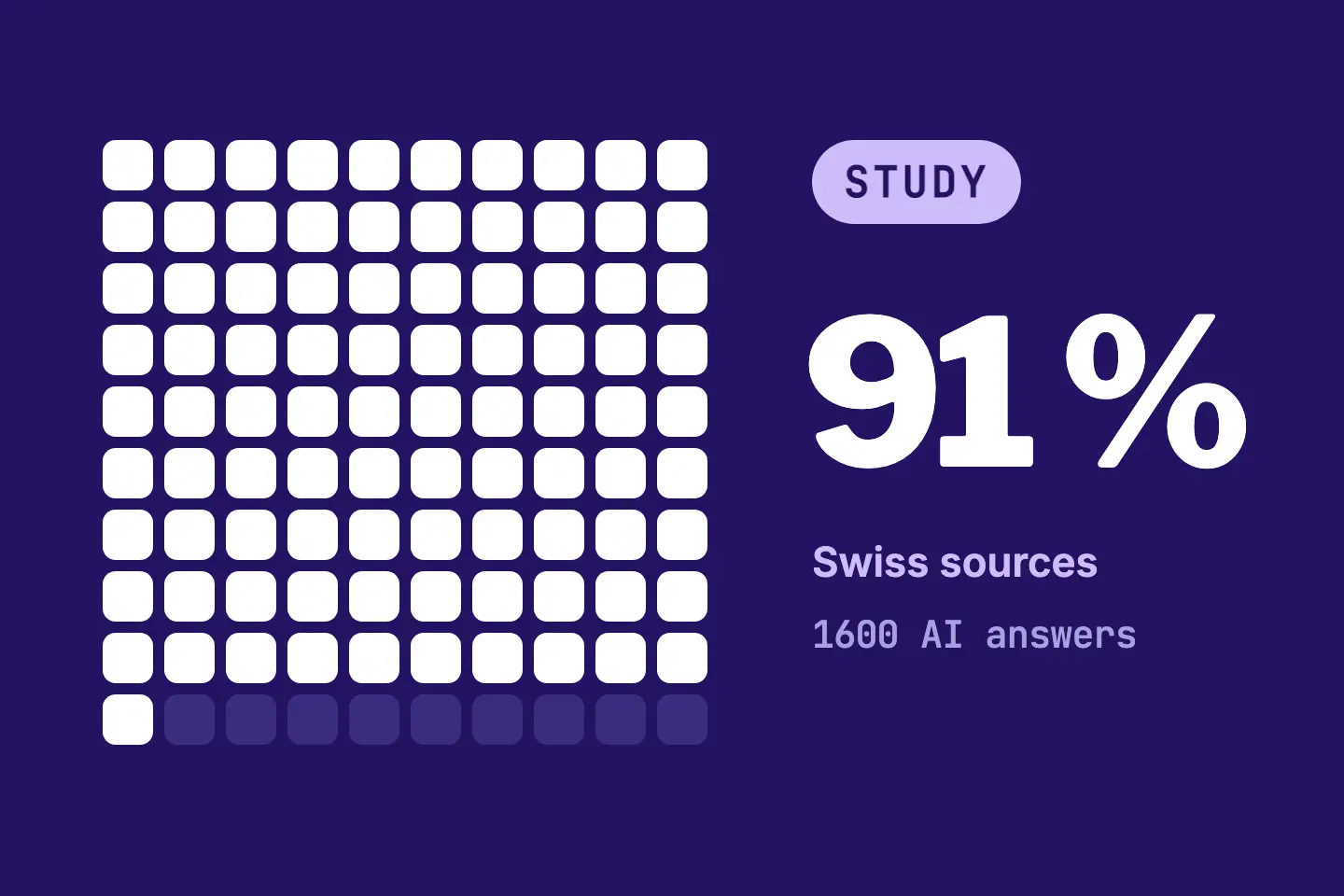
If ChatGPT, Claude, Perplexity or Gemini know that the question comes from Switzerland, most of the cited sources come from Switzerland. If the question does not name the place, three quarters of the sources are Swiss. If it names Switzerland, nine tenths are. An example of the two versions: "What does health insurance not pay for?" and "What does health insurance in Switzerland not pay for?".
Which pages the assistants cite depends strongly on the industry and on the type of question. In retail, they are mainly the pages of the companies themselves. In real estate, a single comparison portal appears in every second answer. This article shows the figures and what your company can take from them.
For the study we asked 100 questions from 10 industries, each without and with a place, to four AI assistants and in two measurements. That gives 1600 answers. We assigned each cited domain a country and a type, for example authority, comparison service or provider.
Disclosure: RankScan is our product, operated by Klarplan AG in Lucerne. RankScan measures how brands appear in AI answers. So we have an interest in the topic. The study ran outside the product. We set the rules for measurement and analysis before the first measurement. What we changed afterwards is listed under "Limits".
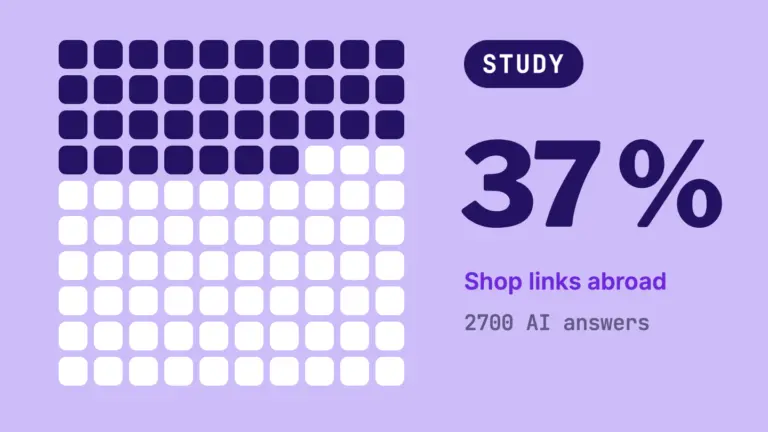
- The assistants cite company pages most often (37 %), then comparison services (18 %) and authorities (16 %). Media and forums are rare.
- When someone asks for a provider ("Which …?"), every fourth source comes from a comparison service. In real estate, banking, health insurance and mobility, comparis.ch or moneyland.ch appears in every third to every second answer with a source.
- The mentions are spread across 805 company domains. The ten most frequent receive only 13.5 % of them together.
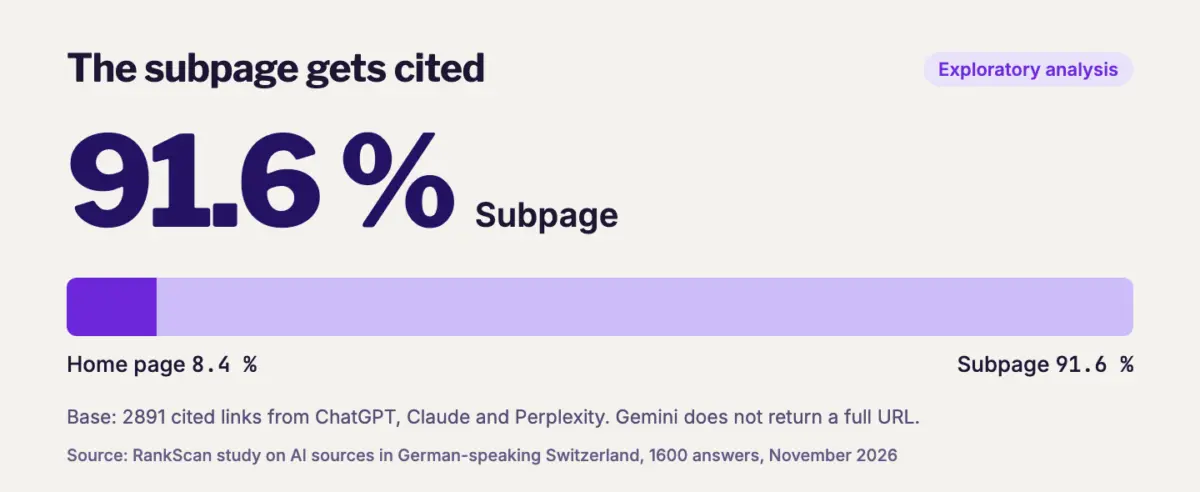
- The cited pages are subpages that answer a question. Only 8.4 % of the links lead to a home page.
- With a Swiss location, 75.6 % of the sources come from Switzerland when the question does not name the place. With a place it is 90.5 %. Health insurance, banking and real estate are always above 90 %, travel without a place is at 52 %.
- The assistants differ: ChatGPT cites an authority for every third source, Claude and Gemini almost never.
How often AI assistants cite Swiss sources #
Across all industries, 75.6 % of the sources come from Switzerland when the question does not name the place. If the question names Switzerland or a Swiss city, it is 90.5 %. In both cases the assistants knew that the question came from Switzerland.
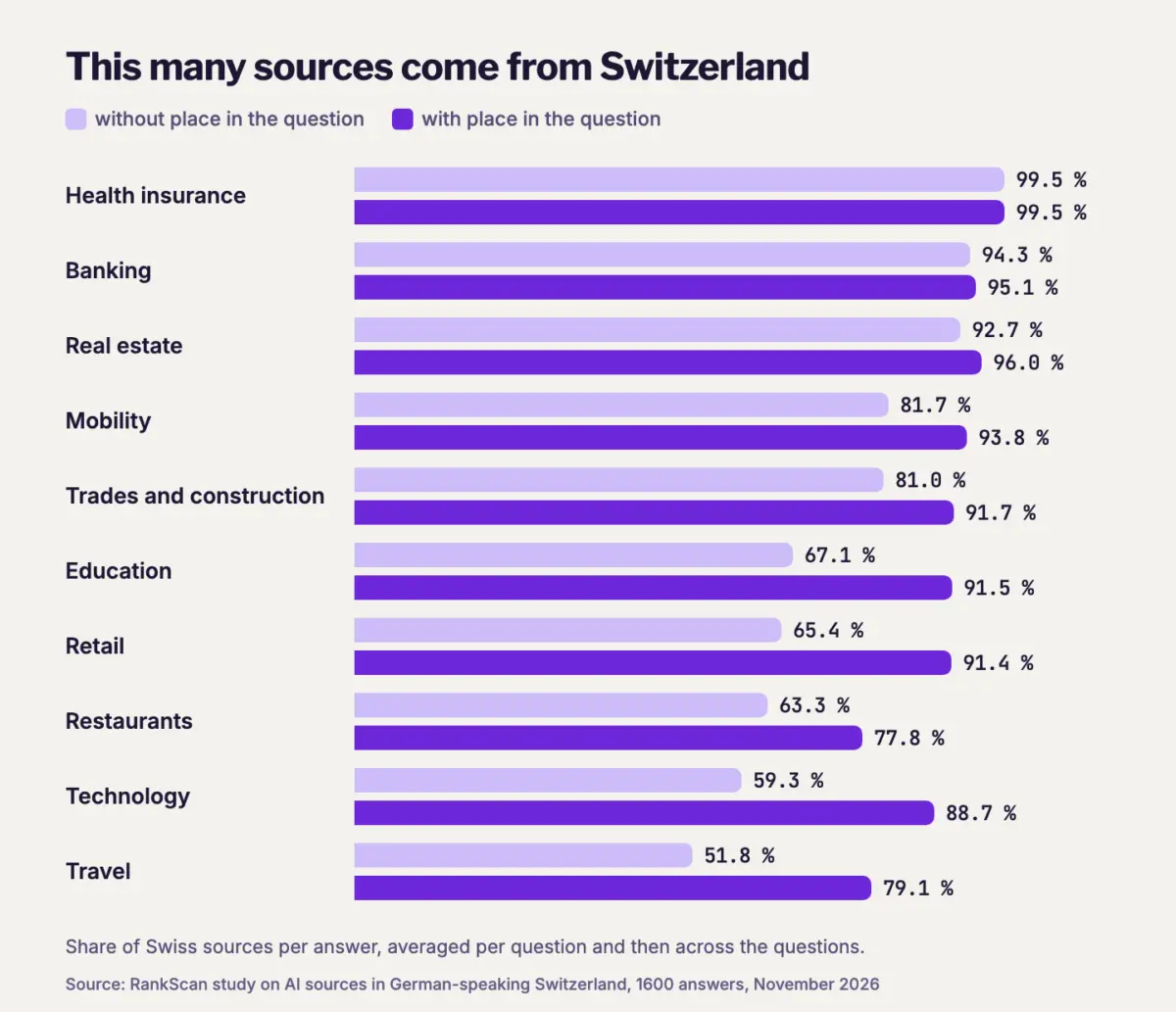
Health insurance, banking and real estate hardly need Switzerland in the question. Terms such as deductible (Franchise) or pillar 3a exist only here, and the assistants find almost only Swiss pages on them. Travel, technology, retail and education are different: there the share with a place is 24 to 29 points higher than without. There are many German pages on these topics. We did not check whether that is the reason.
Without a place, 12.7 % of the sources come from Germany and 1.5 % from Austria. With a place, the share of Germany drops to 3.3 %.
The order in the middle of the field is not certain. The values per industry are based on 10 questions. We therefore do not count differences below about 12 points as a difference. The exact values with their uncertainty are under "How we measured".
What companies can learn from this #
We planned this analysis only after the measurement, based on the question: what does this mean for companies that want to appear in AI answers? The findings are therefore indications, not tested hypotheses. The study measures which pages get cited. It does not measure why, nor whether the answer recommends a company. The advice in this section is our assessment.
What counts in your industry #
The industries differ more than the assistants. The table shows for each industry which type of source appears most often and which comparison portal is named most often.
| Industry | Most frequent types of source | Most frequent portal | What it means |
|---|---|---|---|
| Retail | Company pages 73.3 % | none above 11 % | Your own page counts |
| Technology | Company pages 52.1 % | none above 11 % | Your own page counts |
| Banking | Company pages 45.7 %, comparison services 34.1 % | moneyland.ch 33.6 % | Your own page and the portals |
| Mobility | Company pages 39.8 %, comparison services 23.5 % | comparis.ch 29.3 % | Your own page and the portals |
| Real estate | Company pages 35.3 %, authorities 22.2 % | comparis.ch 49.5 % | One portal appears in every second answer |
| Trades and construction | Company pages 35.0 %, comparison services 20.0 % | daibau.ch 13.4 % | Your own page, the portals are weak |
| Health insurance | Authorities 44.5 %, comparison services 20.4 % | comparis.ch 33.3 % | Authorities and one portal dominate |
| Education | Universities and associations 43.7 %, authorities 23.5 % | none above 11 % | Universities, associations and authorities dominate |
| Restaurants | Company pages 29.5 %, comparison services 16.6 % | michelin.com 13.0 % | Uncertain, 23 % of the sources are not classified |
| Travel | Company pages 29.6 %, authorities 19.6 % | none above 11 % | Uncertain, 21 % of the sources are not classified |
The types of source apply to questions without a place. The value for the portal shows how many answers with a source name the portal, across both versions.
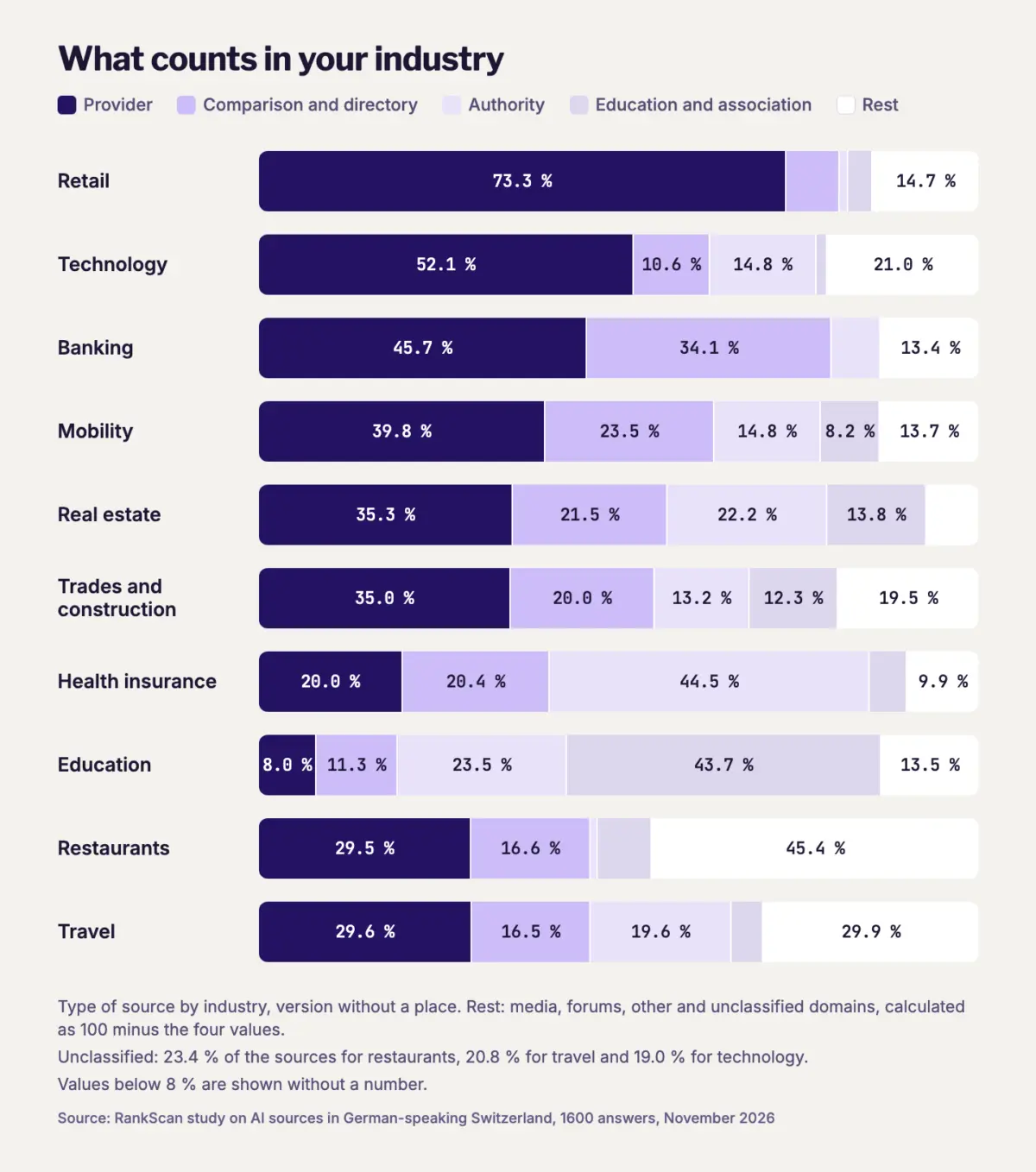
If you sell household appliances or look after the IT of companies, the assistants mainly cite pages like yours. If you are a health insurer, you compete with the Federal Office of Public Health and with comparis.ch. For restaurants and travel the values are uncertain, because we could not classify many domains there.
For "Which company …?" the portals have a say #
The type of question changes the sources. The values apply to questions without a place:
| Type of question | Example | Comparison services | Company pages | Authorities |
|---|---|---|---|---|
| Knowledge | "What does health insurance not pay for?" | 13.1 % | 33.5 % | 23.6 % |
| Choice | "Which providers are suitable for a car subscription?" | 25.7 % | 38.1 % | 11.5 % |
| Local | "Which company does good painting work?" | 13.4 % | 40.9 % | 10.7 % |
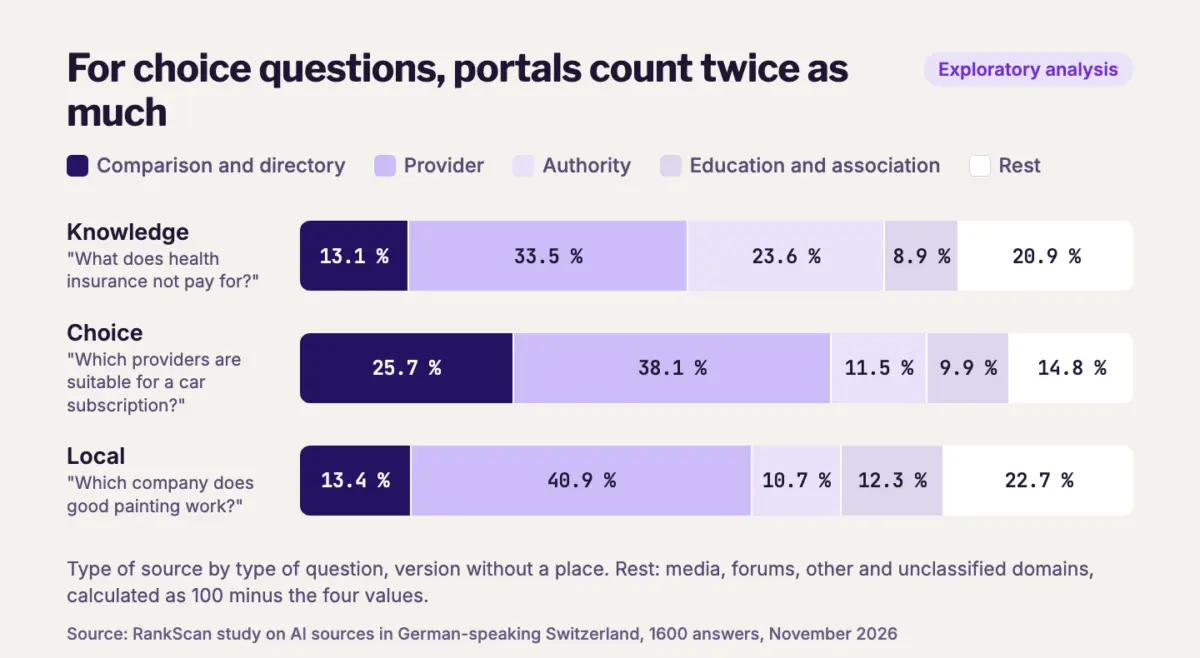
For choice questions, twice as many sources come from comparison services as for knowledge questions. If the question contains a word such as "best" or "cheap", the share rises further: 32.5 % against 13.9 % for questions without such words. These questions also cover other topics, though. How much is due to the word, the study does not show.
In some industries a few portals dominate. The value shows how many answers with a source name the portal:
| Industry | Most frequent comparison services |
|---|---|
| Real estate | comparis.ch 49.5 %, realadvisor.ch 21.1 %, homegate.ch 21.1 % |
| Banking | moneyland.ch 33.6 %, comparis.ch 32.1 % |
| Health insurance | comparis.ch 33.3 %, bonus.ch 14.3 %, vergleichscheck.ch 13.5 % |
| Mobility | comparis.ch 29.3 %, autoscout24.ch 17.1 %, moneyland.ch 11.4 % |
| Trades and construction | daibau.ch 13.4 % |
| Restaurants | michelin.com 13.0 % |
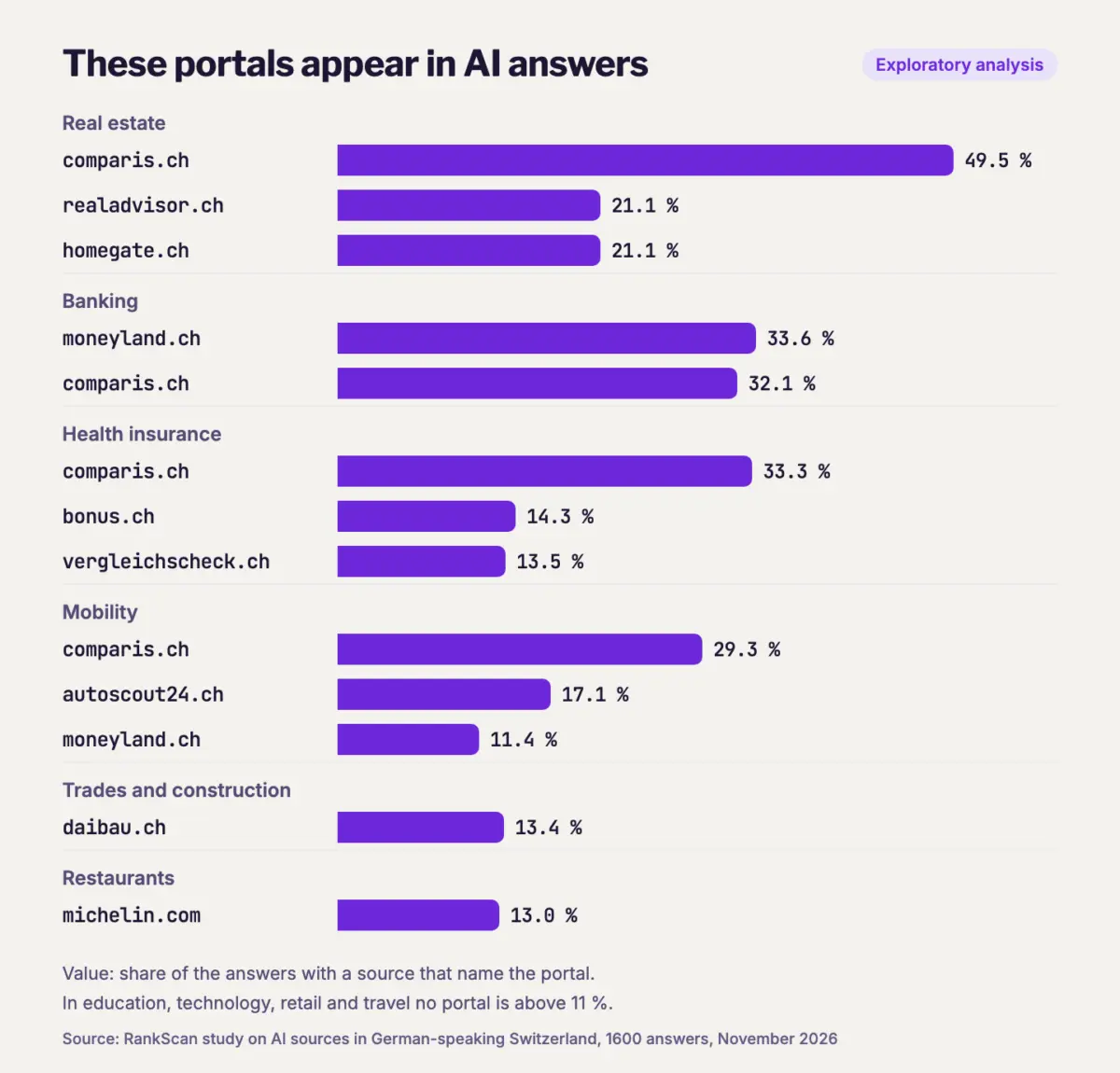
If you work in one of these industries, keep your entry on these portals complete: offer, prices, service area, reviews. Anyone who asks an assistant for the best or cheapest provider often gets an answer that relies on the portal. If your company is missing there or only half listed, it is probably missing from the answer too.
In education, technology, retail and travel, no comparison service is above 11 %. There, the way leads through your own page. Which sources count in your topic, even without your brand, is shown in Relevant sources without your brand.
The page that answers the question gets cited #
An example from the data. The question was: "When is an ERP system worth it for a small company?" 12 of the 16 answers named a source. Among them were these pages from Swiss IT companies. The titles come from the search results of the measurement:
consenso-solutions.ch: "Was ist ein ERP-System und wann braucht ein KMU eines?" (What is an ERP system and when does an SME need one?)redpoint.swiss: "Was kostet ein ERP-System?" (What does an ERP system cost?)outwork.ch: "ERP-Kosten Schweiz: Was KMU 2026 realistisch einplanen müssen" (ERP costs in Switzerland: what SMEs realistically have to budget in 2026)aproda.ch: "ERP Software für KMU: Warum eine ERP-Software entscheidend ist" (ERP software for SMEs: why ERP software is decisive)
None of these domains is among the 25 most frequent company domains of the study. But each of these pages takes up a customer question in its title. The same answers also cited German providers with similar articles.
Across all answers, only 8.4 % of the cited links led to a home page. The assistants link the individual page on which the answer is found.
It does not have to be a blog. Of the links to company pages, only about one in five (19.3 %) had a word such as "blog", "ratgeber" (guide) or "faq" in the address. This figure is an approximation based on the address; we did not read the pages.
Collect the questions customers ask you before they buy. For each one, check whether your website has a page that answers exactly this question: What does it cost? Who is it worth it for? How does it work? What such a page looks like is in Questions with a direct answer.
Many different companies get cited #
The assistants named 805 different company domains as a source. The ten most frequent together received only 13.5 % of the mentions. A quarter of the mentions went to domains that appeared at most twice in 1600 answers.
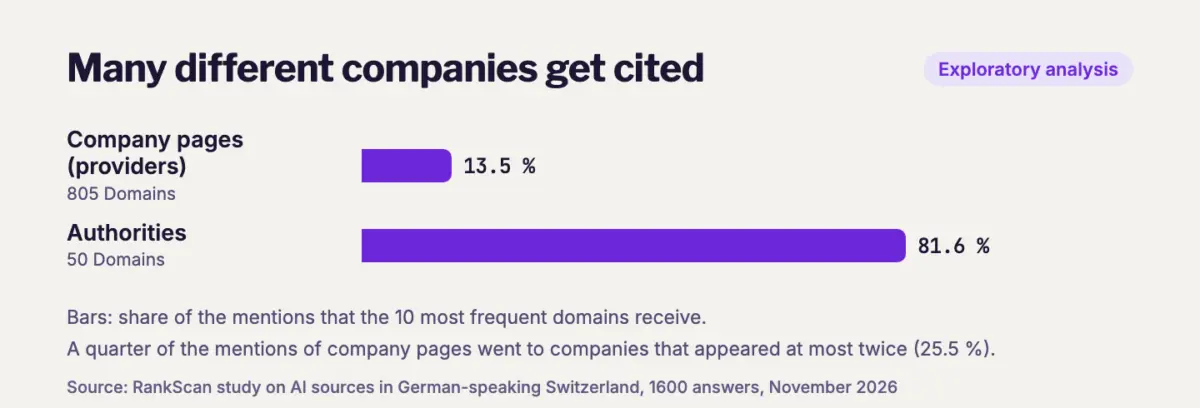
At the top are big brands such as Raiffeisen, UBS and AXA. But they have no lead that takes the place of the others: more than 85 % of the mentions go to other companies. We did not measure how big these companies are.
For authorities it is the other way round. The ten most frequent domains receive 81.6 % of the mentions, led by admin.ch. This domain covers all federal offices.
The location of the person asking counts #
For local questions without a place, such as "Where can I get my phone repaired?", the answers often named a city that was not in the question:
| Assistant | Answers | names Zurich | names Bern, Basel, Lucerne, St. Gallen or Winterthur |
|---|---|---|---|
| ChatGPT | 40 | 33 | 4 |
| Perplexity | 40 | 34 | 2 |
| Gemini | 40 | 25 | 12 |
| Claude | 40 | 6 | 5 |
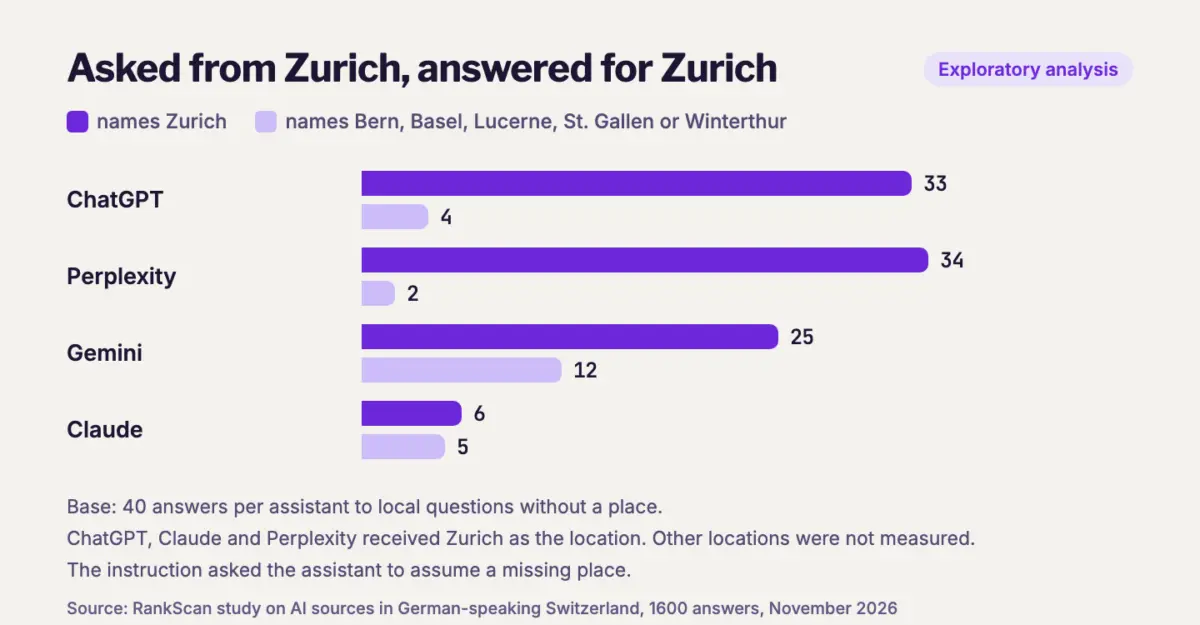
ChatGPT, Claude and Perplexity received Zurich as the location. Our instruction People Also Ask (PAA) is a Google SERP element that shows related questions with expandable answers. It helps users explore a topic further and can affect clicks.Open glossary entry → them to assume a missing place and to state the assumption. ChatGPT then wrote, for example: "I assume you are in Zurich." Gemini received no place and still named Zurich in 25 of 40 answers. Google probably evaluates the IP address, because we asked from Zurich. We did not check this.
We did not measure locations other than Zurich. But the figures suggest: someone asking from Lucerne probably gets different companies named than someone in Zurich.
Ten recommendations for your company #
Recommendations 1 to 3 set priorities, 4 to 7 concern your content, 8 the Swiss reference and 9 and 10 measurement.
- Your industry sets the priorities. Before you allocate budget, first check which sources actually appear for your topics: in retail it is mainly company pages, in health insurance authorities, in education universities and associations. A single strategy for all industries falls short.
- When people choose a provider, comparison portals count most. For questions about a provider, twice as many sources come from comparison services as for knowledge questions, and in real estate
comparis.chappears in almost every second answer with a source. Check your presence on the portals of your industry and keep your offer, terms and company details up to date. - The source slots are widely spread. The ten most frequent company domains receive only a small part of the mentions (see above). This points to opportunities beyond the most cited domains, but the study does not show a particular advantage for small companies. So look for customer questions on which you can provide especially helpful information.
- Your own website is an important starting point. Company pages are the most frequent type of source, especially in retail and technology. Invest in Helpful content refers to content created primarily for people that delivers a clear answer and shows substance, originality and trust, rather than being optimized mainly for search engines.Open glossary entry → on your own website.
- Concrete customer questions are the best starting point. In the ERP example above, the assistants cited pages about costs and about the benefit for SMEs. Collect questions from sales and consulting, such as "What does it cost?", "Who is it suitable for?" or "When is it worth it?", and answer them clearly and with concrete details.
- Optimise the matching subpages. The assistants almost always link a subpage, so every important customer question should find a good answer on a clearly matching page. This can be an existing service page, and closely related questions do not necessarily need a page each.
- A blog is not a requirement. Most cited links to company pages have no word such as "blog", "ratgeber" (guide) or "faq" in the address, even though the address does not reliably reveal the content. So also improve product, service and pricing pages, and do not rely on new blog articles alone.
- Swiss and local references belong in your content and your measurement. Make your location, service area and Swiss specifics clear on your pages, and measure with your customers' location, using questions with and without a place. With a Swiss location, most sources come from Switzerland, and even more with a place in the question; but the figures do not prove a direct effect of such changes to a website.
- ChatGPT alone does not show your AI Visibility describes whether and how visible a brand, website or person is in AI-generated answers. It measures mention, position, description and source linking across multiple platforms and prompts.Open glossary entry →. ChatGPT cites authorities much more often, Gemini company pages (see "The assistants differ"). Ask several assistants the same customer questions, and note: the study measures the An application programming interface (API) is an interface through which software systems communicate and exchange data. It defines how requests are made and answered.Open glossary entry → models with web search, and results in the apps may differ.
- Repeated measurements say more than single hits. The cited domains changed a lot between the two measurements. Track a fixed set of questions regularly and record separately whether your website is cited, your brand is named or your company is recommended. The study only measures source citations, and a citation is not yet a recommendation or a customer enquiry.
How to go about it is in Being mentioned and linked in AI answers.
The assistants differ #
| Assistant | Swiss sources, without a place | with a place | Authorities | Company pages |
|---|---|---|---|---|
| ChatGPT | 90.3 % | 93.6 % | 34.1 % | 27.9 % |
| Perplexity, cited links | 90.1 % | 96.2 % | 23.4 % | 37.4 % |
| Claude | 76.0 % | 92.2 % | 2.3 % | 37.8 % |
| Gemini | 66.5 % | 84.7 % | 2.9 % | 44.7 % |
The shares for authorities and company pages apply to questions without a place.
ChatGPT relies on an authority for every third source, Perplexity for just under every fourth. Claude and Gemini almost never cite authorities. The picture was the same in both measurements. Claude instead cites media (11.9 %) and comparison services (25.2 %) more often, Gemini cites company pages most often.
Gemini has the lowest share of Swiss sources. But Gemini received only the sentence about the location and no location as a parameter. The comparison is therefore not fair. Without Gemini, the share of Swiss sources is 86.4 % without a place and 93.9 % with a place.
For Perplexity, the result depends on what counts as a source. The links in the answer text come from Switzerland in 90.1 % of cases without a place. Of all the search results Perplexity reads in the background, only 49.7 % do. So Perplexity mainly picks the Swiss pages from its results to cite.
A single assistant does not show what AI answers look like overall. Measure several.
Do the sources stay stable? #
There were 7 days between the two measurements. The share of Swiss sources stayed within about 2 points per assistant, with one exception: for Claude it rose from 69.4 to 80.9 % for questions without a place. Claude named a source in only about a third of those answers, so the value fluctuates more.
The individual domains changed a lot. For ChatGPT, just under half of the cited domains were the same in both measurements, for Perplexity a good quarter.
A single query therefore says little about whether your page gets cited. Only repeated measurements give a reliable picture.
How we measured #
We queried the programming interfaces (APIs) of the assistants with web search, from a computer in Zurich. What you see in the ChatGPT app or in Google Search may differ.
| Assistant | Model | Hint about Switzerland |
|---|---|---|
| ChatGPT | gpt-5.6-luna with web search | Sentence in the instruction and location Zurich as a parameter |
| Claude | claude-haiku-4-5 with web search | Sentence and location Zurich as a parameter |
| Perplexity | Agent API, preset fast | Sentence and location Zurich as a parameter |
| Gemini | gemini-2.5-flash with Google Search | only the sentence |
The sentence reads: "The user is located in Switzerland." No location parameter is documented for Gemini. All queries carried the same instruction (system prompt): answer directly, without follow-up questions, and assume missing details such as the place and state the assumption.
Each industry has 10 questions: 4 knowledge questions, 4 choice questions and 2 local questions, each without and with a place. An external person from marketing reviewed the questions before the measurement. We measured on 4 and 11 November 2026, with the same models.
What counts as a source #
A source is a domain that the answer links to or names as evidence, counted once per answer. We calculate the share of Swiss domains per answer and average it first per question, then across the questions. So every question counts equally. Answers without a source are not counted.
The country follows the ending (.ch, .swiss and .li for Switzerland, .de, .at), otherwise the operator's seat according to the legal notice. A Swiss company on .com therefore counts as Switzerland. Global platforms such as YouTube or Wikipedia form a group of their own. Counting only the .ch ending, it is 71.9 % without a place and 85.1 % with a place. Only this value can be compared with studies that count by ending.
The values per industry #
The values in brackets are the 95 % interval. It shows how much the value depends on the choice of questions.
| Industry | Swiss sources, without a place | Swiss sources, with a place | .ch ending, without a place |
|---|---|---|---|
| Health insurance | 99.5 % (98.9–100) | 99.5 % (98.8–100) | 98.5 % |
| Banking | 94.3 % (87.6–98.7) | 95.1 % (87.8–99.4) | 88.2 % |
| Real estate | 92.7 % (90.1–95.4) | 96.0 % (93.3–98.4) | 85.4 % |
| Mobility | 81.7 % (67.9–92.4) | 93.8 % (89.6–97.3) | 77.0 % |
| Trades and construction | 81.0 % (77.5–84.1) | 91.7 % (88.2–95.1) | 83.9 % |
| Education | 67.1 % (44.6–86.4) | 91.5 % (84.4–97.6) | 65.6 % |
| Retail | 65.4 % (43.4–86.1) | 91.4 % (86.6–95.9) | 64.3 % |
| Restaurants | 63.3 % (43.4–81.0) | 77.8 % (68.1–87.6) | 55.2 % |
| Technology | 59.3 % (42.7–75.8) | 88.7 % (82.7–94.7) | 52.9 % |
| Travel | 51.8 % (35.1–66.8) | 79.1 % (66.8–88.5) | 47.8 % |
| All industries | 75.6 % (69.9–80.9) | 90.5 % (88.0–92.8) | 71.9 % |
The types of sources #
| Type of source | without a place | with a place |
|---|---|---|
| Provider: companies that sell what was asked about | 36.8 % | 38.1 % |
| Comparison and directory: comparison services, portals, directories | 18.2 % | 19.4 % |
| Authority: federal government, cantons, municipalities and public bodies | 16.2 % | 16.5 % |
| Education and association: universities, associations, foundations | 10.0 % | 9.8 % |
| Media: editorial media | 4.2 % | 4.7 % |
| Other: reference works, blogs | 3.8 % | 3.8 % |
| Forum and review: user content, video | 0.6 % | 0.5 % |
The rest up to 100 % are domains that we did not classify.
The test on location #
In a separate test we asked ChatGPT, Claude and Perplexity 15 questions, each without and with a place, in three variants and twice each. That is 540 answers, counted by ending.
| Variant, question without a place | Share .ch | Share .de |
|---|---|---|
| No hint about Switzerland | 3.3 % | 63.2 % |
| Sentence "The user is located in Switzerland." | 66.8 % | 11.3 % |
| Sentence and location Zurich as a parameter | 70.3 % | 8.5 % |
Without any hint, the assistants cite mostly German sources, even when queried from Zurich. The sentence about the location raises the .ch share by about 66 points; the parameter adds little on average. If the question itself names Switzerland, the .ch share is 86 to 88 % in all three variants.
A measurement tool for AI visibility must therefore set the location explicitly. Otherwise it mainly shows German sources. More on this in Measuring AI visibility.
How the results compare with other studies #
Other studies ask other questions, measure other assistants and count differently. Their figures therefore cannot be set off against ours; only the direction can be compared. Several of these studies come, like ours, from companies that sell tools or advice for AI visibility. They are marked "vendor" here.
Two analyses from Switzerland find far fewer Swiss sources than we do. The fög at the University of Zurich asked ChatGPT and Perplexity questions about the news in July 2025, in German and French. Swiss sources made up 22.2 % (ChatGPT) and 33.1 % (Perplexity) of the citations, and 54.1 and 73.9 % for questions related to Switzerland. Ahrefs (vendor) analysed the domains ChatGPT cited most in Switzerland in September 2026. Among the 50 most cited domains, 18.6 % of the citations went to .ch and 22.5 % to .de by ending. By ending, our value is 71.9 % .ch without a place. The questions probably explain most of the difference: the fög also asked about international news, Ahrefs derives its questions from A keyword is the search term users enter into a search engine to find information, products or providers. Keywords are the basis against which rankings and visibility are measured.Open glossary entry →, and we only asked questions about everyday topics in Switzerland. In addition, Ahrefs counts the most cited domains, while we count each domain once per answer. We have not tested this explanation.
The studies agree that Swiss sources hardly appear without a reference to Switzerland. At the fög, their share for questions without a geographic reference was 4.4 % (ChatGPT) and 1.7 % (Perplexity). In our experiment without any hint about the location, 5 of 231 sources came from .ch pages, or 2.2 %. For ChatGPT and Perplexity, there were none at all. For CH Media, an AI specialist asked assistants about Swiss politics. According to him, up to 70 % of Gemini's sources sometimes came from Germany. In our study, too, Gemini had the lowest share of Swiss sources.
The type of source shows how much the questions matter. The fög asked about the news, and 73.2 % of ChatGPT's citations came from media. In our study, media are rare at 4.2 %. An analysis from Germany, on ChatGPT only, is closer to our questions: Among the 1,000 most cited pages in Germany, company pages received 24.7 % of the citations and authorities and public research 24.0 %, as Ahrefs (vendor) shows. In our study, ChatGPT also often cites authorities (34.1 %) and company pages (27.9 %), while across all four assistants company pages are higher (36.8 %) and authorities lower (16.2 %). Measuring only ChatGPT therefore shows more authorities than the average of the assistants. In Germany, Ahrefs found only 8.6 % of the most cited company pages on a blog, magazine or guide path; the rest were product, service and overview pages.
Limits of the study #
- The study measures the API models with web search. Copilot is missing, and we did not measure the app interfaces.
- Claude did not search in about half of the answers and then named no source, mainly for questions without a place. We did not clarify why. The values apply only to answers with a source.
- For Perplexity we could not read a link in about half of the answers. A quarter of these answers contained citation markers that our script could not assign to a link. A test with these citations changed the main values by at most 0.1 points.
- The instruction asked the assistants to assume missing details such as the place. This affects how often the answers name a city.
- The assignment of country and type was prepared by machine: a script read the title, description and legal notice, and a A Large Language Model (LLM) is an AI model that learns from large amounts of text and generates formulated answers from it. LLMs form the core of generative answer systems such as ChatGPT, Perplexity or Gemini.Open glossary entry → suggested the class. A second person checked 10 % of the domains independently. Agreement was 95.9 % for the country and 89.0 % for the type (Cohen's kappa 0.91 and 0.82).
- The classified domains cover 91 % of all citations. Because we count each domain once per answer, part of the type is missing depending on the industry. The gap is largest for restaurants (23 %), travel (up to 21 %) and technology (up to 19 %).
- The section for companies is an analysis made after the measurement. We did not measure company size.
- We reworded 4 of the 100 questions after the review. The reviewer did not see this wording. Without these 4 questions, the share of Swiss sources rises by 1.9 points without a place and 0.7 points with a place.
- The second measurement ran after 7 instead of the planned 14 days. The stability applies only over 7 days.
- The study says nothing about brands, about trends or about why a domain is cited.
Frequently asked questions about the sources of AI assistants in Switzerland #
Which sources do AI assistants use in Switzerland?
With a Swiss location, three quarters of the sources cited by ChatGPT, Claude, Perplexity and Gemini are Swiss when the question does not name the place. If the question names Switzerland, it is nine tenths. The most frequent are company pages, comparison services and authorities. This is shown by our study of 1600 answers from November 2026.
How does my page appear as a source in AI answers?
The study measures which pages get cited, not why. Two findings point in a direction: more than 90 % of the cited links lead to subpages, and for questions about a provider every fourth source comes from a comparison service. A clearly matching page for each important customer question and a complete entry on the portals of your industry are therefore an obvious start. This can also be an existing service page.
Does my company have to be big to appear in AI answers?
The study does not measure company size. But it shows that the mentions are widely spread: across 805 company domains, of which the ten most frequent received only 13.5 % of the mentions. For the question about an ERP system, for example, the assistants cited articles by Swiss IT companies that otherwise hardly appeared in the study.
Which comparison portals do AI assistants cite in Switzerland?
Most often comparis.ch and moneyland.ch. In real estate, every second answer with a source named comparis.ch; in banking, a third each named moneyland.ch and comparis.ch. In education, technology, retail and travel, no portal was above 11 %.
Does ChatGPT cite Swiss sources?
Yes, if ChatGPT knows the location. With a Swiss location, 90.3 % of the cited sources came from Switzerland, even for questions without a place. Without any hint about the location, none of ChatGPT's sources in our test came from a .ch page, even though the requests were sent from Zurich.
Why do AI assistants often cite German pages?
If the assistant does not know the location, it usually treats a question in German as a question from Germany. In our test without a hint, 63 % of the sources came from .de pages. Even with a Swiss location, German sources remain frequent when the question does not name the place, especially in travel, technology and restaurants.
Conclusion: industry and question decide the sources #
Whether your company appears as a source in AI answers depends first on your industry. In retail and technology, the assistants mainly cite company pages. There, your own website counts. In banking, real estate, health insurance and mobility, comparison portals such as comparis.ch and moneyland.ch often appear in the answer, especially when someone asks for a provider. For knowledge questions, the assistants often cite authorities.
For your customers in Switzerland, the assistants mostly name Swiss pages, provided they know the location. The mentions are spread across many companies, and almost every cited link leads to a subpage. In our assessment, a page that answers a customer question is therefore the likely way into the answer. The study does not measure why a page gets cited.
What you can derive from this is in the ten recommendations in the section for companies. The first step: check which pages the assistants cite today for your customers' questions.
RankScan asks ChatGPT, Claude, Perplexity and Gemini your customers' questions, with a Swiss location. So you see which sources the answers cite and whether your page is among them.