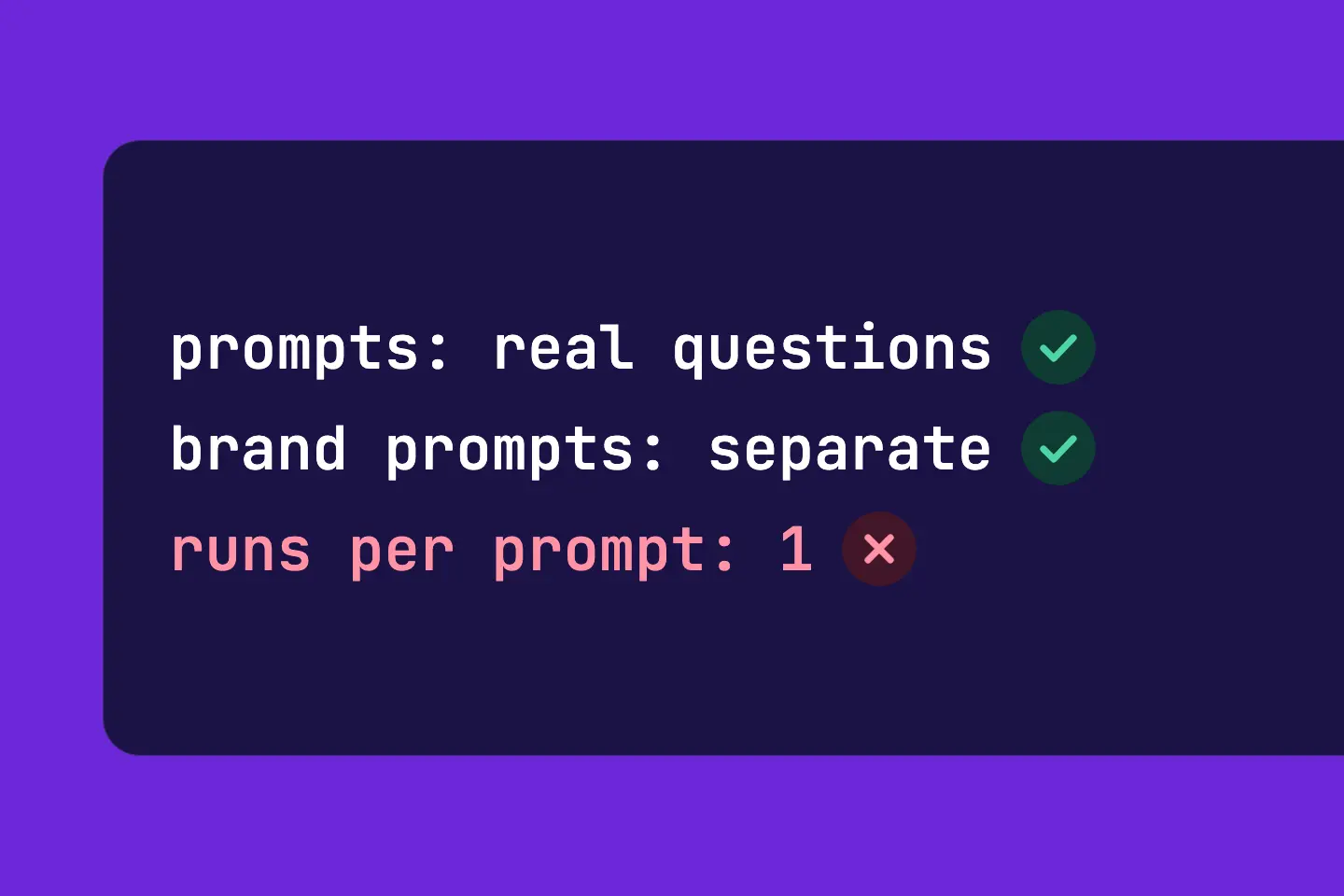
A good tool measures how often AI assistants name and link your brand on their own for real customer questions, repeatedly over time and separately for each assistant. It discloses how it measures. It shows you the answers and sources behind every figure. If one of these points is missing, the figure says little about your visibility.
But a good figure alone changes nothing. A good tool also tells you clearly what to do next.
This guide gives eight criteria with reasons, a checklist for your trial and the limits of every measurement.
Disclosure: RankScan is our product, so we sell such a tool ourselves. For each criterion we therefore also state where RankScan stands and where it has limits. We read the details about other tools on their pricing pages on 4 November 2026. They can change.
No AI Visibility describes whether and how visible a brand, website or person is in AI-generated answers. It measures mention, position, description and source linking across multiple platforms and prompts.Open glossary entry → figure is an exact value. It is an estimate, and a good tool treats it as one.
- Count only prompts without your brand name. A prompt that contains your brand is almost always won by your brand.
- A single answer is not a measurement. The same question rarely returns the same list of brands twice.
- Frequency over many runs is more reliable than the position in an answer.
- The An application programming interface (API) is an interface through which software systems communicate and exchange data. It defines how requests are made and answered.Open glossary entry → and the user interface return different answers. Ask for the measurement path of each assistant.
- Convert the price to answers. Otherwise you cannot compare prompts and credits.
- Test each tool with your own prompts. Read some raw answers yourself.
- Check the measures: can someone without Search Engine Optimization (SEO) covers all measures that help a website become more visible in unpaid (organic) search results.Open glossary entry → knowledge understand what to do next?
- No tool sees what your customers really ask. You measure revenue and enquiries in other ways.
The eight criteria at a glance #
| Criterion | Question for the vendor | Warning sign |
|---|---|---|
| Prompts | Where do the prompts come from? | Only generated prompts that you cannot change |
| Brand and discovery prompts | Do prompts with my brand enter the score? | One figure mixes both kinds |
| Assistants and path | Which assistants, through which path? | No statement on the path |
| Sources and citations | Do you separate mention, citation and search result? | Only one "visibility" figure |
| Variation | How often does a prompt run? Do you show the uncertainty? | A rank without any statement on spread |
| Countries and languages | How does the country affect the query? | "Global" without an explanation |
| Pricing model | What does one answer cost? | A price without a calculation |
| Clear measures | Can someone without SEO knowledge understand the next step? Which finding supports it? | Many charts, no next step, or general tips |
1. Prompts from real customer questions #
A measurement can only be as good as its questions. A prompt set of industry terms shows how visible you are for industry terms. Your customers may ask differently.
Build the set from sources you already have: questions from sales, from support and from your website's search queries. Add questions that trigger a choice, for example: "Which provider is suitable for …?"
Check three things in the tool:
- You can write and change every prompt yourself.
- The tool warns about prompts that already name your brand.
- The tool does not state how often people ask this exact question, or it explains where such a figure comes from.
How RankScan does it: You write the prompts yourself, or you generate them and change them afterwards. RankScan shows no search volume per prompt.
2. Brand and discovery prompts kept apart #
This is the most important criterion. The question "Is Example Ltd a good provider?" already names your brand. The assistant almost always repeats it. Such a hit does not show whether someone who does not know you yet can find you.
Both kinds are useful:
- Discovery prompts do not name your own brand. They show whether an assistant names you on its own.
- Brand prompts name your brand. They show how an assistant describes you.
If a tool mixes both kinds in one figure, your visibility looks better than it is. So ask which prompts enter the main figure.
How RankScan does it: The metrics count only prompts without your brand name. Follow-up questions and refusals from the assistant do not count either, because they are no measurement. RankScan shows brand prompts separately. A A Large Language Model (LLM) is an AI model that learns from large amounts of text and generates formulated answers from it. LLMs form the core of generative answer systems such as ChatGPT, Perplexity or Gemini.Open glossary entry → classifies the answers, and it is not free of errors.
3. Assistants and path: API or user interface #
First check whether the tool measures the assistants your customers use. Also ask which of them the price includes. According to its pricing page, Otterly lists Claude, Gemini and Google AI Mode as paid add-ons. According to its pricing page, Peec AI reserves some assistants for the Enterprise plan.
Then the measurement path matters. There are two:
- API: The tool calls the model through the vendor's interface.
- User interface: The tool reads the answer from the product that people see in the browser. This is also called scraping.
The two paths return different answers. In August 2026, Surfer compared both paths with 1,000 prompts. The brands named overlapped by only 15.5 to 23.8 %. ChatGPT cited 12.1 sources on average in the app and 3.1 through the API. Perplexity was the reverse: 19.5 sources through the API and 10.3 in the app.
Read such figures with care. Surfer itself sells a tool with user interface data and took only one sample per prompt. Part of the difference can therefore also be normal variation. This is our assessment, the study does not separate the two. Conductor sells a tool with API data and argues the opposite: scraping is fragile and often violates terms of service. Conductor presents no data for this.
So neither path is simply right:
| API | User interface | |
|---|---|---|
| Strength | stable, well documented, same conditions for each run | closer to what a person sees |
| Weakness | can differ from the product | can break, one session covers only one state, check the terms of service |
So ask the vendor for the path, model and web search of each assistant. A clear answer matters more than the path itself.
How RankScan does it: You choose from ChatGPT, Gemini, Claude, Perplexity and Microsoft Copilot. For each property, RankScan measures 2, 3 or 4 of them, depending on the plan. No plan measures all five at once. RankScan queries ChatGPT, Gemini, Claude and Perplexity through the API with web search. RankScan reads Copilot from the user interface through a service provider. On the API, RankScan also sends the assistant an instruction: answer directly and ask no follow-up question. The model can differ from the one you see in the app. The answers are therefore close to the product, but not identical. RankScan measures AI Overviews are AI-generated answer boxes from Google that appear above the classic search results. They summarize information from the web and can change click distribution.Open glossary entry → separately through Google Search. RankScan does not measure Google AI Mode today.
4. Sources and citations #
A mention and a link are two different things. An assistant can name you without linking your website. It can also cite a third-party page that does not mention you. Only the sources show you where to start.
A good tool shows separately:
- whether your brand is named,
- whether your website is cited,
- which third-party pages the answer cites,
- whether these pages name your brand.
Also ask what counts as a source. A page in the search results does not prove that the assistant read it or used it in the answer. The assistants also deliver different amounts of detail here. A comparison across all assistants therefore stays imprecise.
How RankScan does it: The Citation Rate measures the share of relevant AI answers in which a website is linked or named as a source. It is a monitoring metric, not an official ranking factor.Open glossary entry → counts how many answers with your brand also link your website. RankScan keeps citations and search results apart. Not every assistant delivers the same details: from Gemini, for example, RankScan records only the host name of a source. The article on AI mentions and citations explains how the values relate.
5. Variation in single answers #
AI answers vary a lot. SparkToro and Gumshoe had 600 volunteers put 12 prompts to ChatGPT, Claude and Google's AI answers, 2,961 times in total. According to the study, the chance that ChatGPT or Google's AI returns the same list of brands twice in 100 runs was below 1 in 100. The same order was rarer still.
The study draws a clear conclusion: the share of answers with your brand is usable over many runs. A "position" in AI answers is not. The study is not peer-reviewed, and the authors themselves call their sample too small for a final verdict. Gumshoe also sells such a tool.
A statistical paper by Ronald Sielinski (IQRush, version of 26 August 2026) supports this caution. It put 200 questions per topic to Perplexity, OpenAI SearchGPT and Gemini. According to the paper, single runs look more precise than they are. In its data, the confidence intervals of domains usually overlap when the gap in citation share is below 5 to 7 percentage points. Such gaps are then often no real difference. The paper covers three consumer topics. It does not derive a minimum number of questions for all cases.
This leads to three questions for every tool:
- How often does each prompt run, and how many prompts do I need for a statement?
- Does the tool show the uncertainty, or only a figure with decimals?
- Does the tool present a position as a rank? Then ask over how many runs it is averaged.
How RankScan does it: RankScan puts each prompt to each assistant once per measurement run, every two days by default. RankScan therefore repeats over time, not at the same moment. RankScan shows no confidence interval. Early mention (first three sentences) is therefore a trend, not a rank. Read the history, not the single value. The Starter plan includes 10 prompts. This shows a direction, but no fine differences between two brands.
6. Countries and languages #
For the same question, an assistant often names different providers depending on language and country. A Swiss small business gains little from a measurement that asks in English from the USA.
So ask:
- Can I set the country for each measurement?
- How does the country take effect? Through a sentence in the prompt, an API setting or a location in the user interface?
- Are the prompts written in my language, or does the tool translate them?
- Can I evaluate several countries separately?
The country mainly takes effect through web search. It does not replace a real user on site. A measurement for one country stays an approximation.
How RankScan does it: The country belongs to the property. If it is set, RankScan tells the assistant where the person asking is located. RankScan also asks the assistant to answer in the language of the prompt. For several markets, you create several properties.
7. Pricing model: prompts or credits #
Pricing pages can rarely be compared directly. Three examples, as of 4 November 2026:
- Rankscale charges in credits. According to its pricing page, one query typically costs 0.25 credits per assistant and prompt.
- Otterly charges in prompts with daily measurement. Four assistants are included, others cost extra.
- Peec AI charges in prompts. According to its pricing page, the number of answers per month results from prompts, active models and measurement frequency.
So convert each offer to the same unit:
Answers per month = prompts × assistants × measurement runs per month
Price per answer = monthly price ÷ answers per month
An example with invented figures: 50 prompts, 3 assistants and 15 measurement runs result in 2,250 answers. At 150 francs a month, one answer costs about 7 centimes.
The lowest price per answer does not win automatically. Also compare what one more prompt costs and whether an additional assistant changes the price.
How RankScan does it: The plan limits the prompts in the account: 10, 35 or 100. There are no credits for the measurement. Current prices are on the pricing page. RankScan offers more prompts in the Enterprise plan on request.
8. Clear measures with evidence #
In daily work, this criterion decides the most. The measurement shows you where you stand. You only become more visible when someone changes something. Often this is not the person who operates the tool, but the editorial team, the agency or the developers. If this person does not understand the recommendation, the figure has no effect.
A comparison with invented examples:
| Weak | Strong |
|---|---|
| "Strengthen your authority in AI answers." | "Answers about e-bikes name you, but rarely link you. Choose one page for this topic and put prices and models on it as text." |
| "Generative Engine Optimization (GEO) covers measures that improve the chances of a brand or website being found, understood, extracted, classified and used as a source by generative AI answer systems. GEO extends classic SEO rather than replacing it.Open glossary entry → score: 43" | "Two trade portals name your competitors, but not you. Check your listing there." |
A good measure states:
- the finding in plain words,
- the evidence, for example the answers and sources behind it,
- the reason why the finding matters,
- the steps in the right order,
- the effort and who can do the work,
- a way to check the effect.
Quantity matters too. 200 equally weighted items do not help you. A good tool tells you where to start.
Be careful with general tips and firm promises. Google also names no special technique that guarantees inclusion in its AI features.
The simplest test: Give a measure from the tool to someone without SEO knowledge. Can this person say what to do and why?
How RankScan does it: We see the clear measures as RankScan's greatest strength. This is our own assessment, and no independent review exists. One example is "AI answers rarely link to your website". The measure appears when fewer than 20 % of the answers with your brand link your website. It states the problem, recommendation and steps, and it rates severity, effort and type of work, here editorial. RankScan orders the measures by relevance, severity and effort. With "Delegate" you send them by email to an external person, who needs no account. The next measurement checks the finding.
This also has limits. A measure is based on fixed rules and does not know your business, so it guarantees no mention. "Resolved" only means that the finding is gone. It does not prove that your work was the cause. Assistants and sources also change without you.
Checklist for your choice #
Test a tool with your own data before you commit. This checklist helps.
Before the trial
- Note 10 to 20 prompts from real customer questions, without your brand
- Choose three direct competitors
- Choose assistants, language and country
- Set a monthly budget and the reports you need
Questions for the vendor
- Which prompts enter the main figure?
- Which path, which model, with or without web search, for each assistant?
- How often does each prompt run?
- How does the country affect the query?
- What does one answer cost, and which assistants cost extra?
- Can I export the raw data?
- How does a recommendation come about, and which finding supports it?
During the trial
- Read five raw answers and recount the detected brands
- Check whether wrong spellings or unrelated brands are counted
- Check whether a follow-up question counts as "not mentioned"
- Open a cited source and check whether it fits the statement
- Compare the same prompt over several measurement runs
- Trace a measure back to the answers
- Give a measure to someone without SEO knowledge and ask what to do
If a tool fails a point, it is not automatically bad. But you then know what you must not use the figure for.
What AI measurement cannot do #
Every tool reaches the same limits, including RankScan:
- Real questions: The vendors do not publish what people ask. Every tool therefore measures a model of your customer questions, not the questions themselves.
- Personal answers: History, memory, login and location can change an answer. No tool sees the answer of one specific customer.
- Reach: A mention says nothing about how many people saw it.
- Cause: If the value rises after a change, the change is not necessarily the reason. Models and sources change without notice.
- Enquiries and revenue: AI visibility does not measure these. A source question in your contact form helps more here.
- Comparison between tools: Two tools calculate differently. You cannot compare their values directly. Compare only the history within the same tool.
So a measurement does not replace your judgement. It shows you a direction and the places where you should read on.
When RankScan fits and when it does not #
RankScan fits if you are not looking for another chart, but want to know what to do next. This applies especially to small teams without their own SEO department and to agencies that pass on tasks. RankScan shows AI visibility, Google rankings and Website Health in one place and derives measures from them. The measurement itself is described on the AI Visibility page.
Another tool probably fits better if:
- you want to capture exactly the answers from the ChatGPT app. Then you need a tool that measures the user interface.
- you must measure Google AI Mode, Grok or other assistants outside our five.
- you want to measure daily or more often, or you need all five assistants at once.
- you need hundreds of prompts and want to prove fine differences between two brands.
FAQ About Measuring AI Visibility #
How do you measure AI visibility?
You put fixed prompts without your brand to AI assistants, repeatedly and separately for each assistant. Then you count how many answers name your brand and link your website. The article on Generative Engine Optimization explains what this tells you.
Can I measure AI visibility without a tool?
Yes, for a first Impressions indicate how often a website's search result was shown in Google Search, regardless of whether it was clicked. They are a core Google Search Console metric and reflect a page's raw visibility for given queries.Open glossary entry →. Put 10 prompts to two assistants several times and note the brands in a spreadsheet. Over weeks and several assistants, this becomes laborious. Also note that your own session can influence the answers.
How many prompts do I need?
There is no generally proven minimum. For a direction, a few prompts per topic are enough. To compare two brands with similar values, you need far more. Sielinski's paper put 200 questions per topic and still found overlapping intervals at small gaps.
Is the API or the user interface better?
Neither path is better for everything. The user interface is closer to what a person sees. The API is more stable and better documented. What matters is that the vendor discloses its path for each assistant.
How do I recognise a good recommendation from a tool?
It states the finding in plain words, the evidence behind it and the next steps. Someone without SEO knowledge understands what to do and why. General tips or a score without a next step are not enough.
What is the difference from share of voice?
Share of Voice in AI answers measures the proportion of mentions a brand receives within a prompt set compared to competitors. It indicates the competitive position in AI answers.Open glossary entry → relates your mentions to all brands in the competitive field. It is one of several metrics a tool delivers. Details are in the article on AI reputation and share of voice.
What does an AI visibility tool cost?
On their pricing pages of 4 November 2026, Rankscale, Otterly and Peec AI state about 20 to about 500 US dollars a month, plus Enterprise plans. RankScan costs 49 to 599 US dollars a month. Convert each offer to answers per month, otherwise you compare different units.
Conclusion: ask how the figure came about #
A nice curve does not prove a good measurement. Check which prompts count, how the answers come about and whether you can read them yourself. Convert the price to answers. Plan a trial with your own questions.
Finally, check what you can do with the figure. A good tool tells you clearly what to do next. It also tells you what it does not know.
Sources and further information #
- SparkToro: AIs are highly inconsistent when recommending brands or products, 28 January 2026, revised 28 June 2026
- Ronald Sielinski: Quantifying Uncertainty in AI Visibility, arXiv, version of 26 August 2026
- Surfer: Why You Cannot Track AI Visibility Through an API, as of 4 October 2026 (vendor of a tool with user interface data)
- Conductor: Scraping vs. API, as of 12 January 2026 (vendor of a tool with API data)
- Google Search Central: AI features and your website
- Rankscale: Pricing, read on 4 November 2026
- Otterly: Pricing, read on 4 November 2026
- Peec AI: Pricing, read on 4 November 2026