You tidy up your website and delete a page. You remove the links to it, and the An XML sitemap is a machine-readable file listing a website's important URLs. It helps search engines discover content more efficiently but does not replace internal linking or guarantee indexing.Open glossary entry → is clean. Google still shows the address in its results. Anyone who clicks lands on an error page.
That is normal. Google only notices that a page is gone on its next visit, and the Google Search Console (GSC) is a free Google tool that shows how a website performs in organic search, with data on impressions, clicks, click-through rate and average position, plus indexing and technical issues.Open glossary entry → data lags by weeks. The only question is: what should a visitor see who calls up the old address?
In RankScan, the matching measure is called «Deleted pages still in Google». It lists the pages that no page of your website links to any more but that Google still shows.
A deleted page is not an error. It calls for a decision: a A redirect forwards users and search engines from one URL to another. It can be permanent (301) or temporary (302) and transfers signals to the target URL.Open glossary entry → to a matching page or a clear «this no longer exists».
- After every full Crawling is the process by which a search engine bot fetches a URL and downloads its content. It is the first step before a page can be indexed.Open glossary entry →, RankScan checks the addresses Google knows. If one of them returns a 4XX error such as 404 or 410, no page of your website links to it and it still has demand in Google, the finding appears.
- Classification in RankScan: severity medium · effort low · work type development. If no page reaches 5 clicks or 100 Impressions indicate how often a website's search result was shown in Google Search, regardless of whether it was clicked. They are a core Google Search Console metric and reflect a page's raw visibility for given queries.Open glossary entry → at an average position of 10 or better, the measure is only a hint.
- The measure needs a connected Google Search Console. Without it, the measure does not appear.
- If a page on the same topic exists, redirect there with a 301. RankScan suggests a page.
- Never redirect to the home page or to any page. Google usually treats that as a A soft 404 is a page that looks like an error page or redirects irrelevantly but technically sends status code 200. Search engines may wrongly treat it as a valid page.Open glossary entry →.
- If no matching page exists, 410 or 404 is right. Google treats both the same.
- Before a 410, check under «Links» in Search Console whether other websites link to the address.
- How it is checked: Report the measure as done. The next full crawl checks every address.
Why Google still shows deleted pages #
Google does not visit a page every day. Only on its next fetch does the crawler see the 404 or 410 status and drop the address from the Indexing is the step in which a search engine processes crawled content and decides whether a URL is added to the search index. Only indexed pages can appear in search results.Open glossary entry →. Until then it stays in the results.
Search Console also shows clicks and impressions over time windows. In the first weeks after the deletion these figures still contain the demand from before. That is useful: you see what the page had and can decide whether a redirect is worth it.
What does «Deleted pages still in Google» mean? #
Classification in RankScan: severity medium · effort low · work type development.
Besides the linked pages, RankScan also crawls the addresses Google knows from Search Console. The measure appears for an address when:
- it returns a 4XX error in the crawl (except 429), usually 404 or 410, or ends on the home page through a redirect,
- no page of your website links to it,
- with a 4XX error, it is not in your Extensible Markup Language (XML) is a flexible text format for storing and exchanging data in a structured way. In the SEO context, the XML sitemap is best known.Open glossary entry →,
- it is not a page of one of your topics and not the home page,
- it had at least 10 impressions or 1 click in Google in the last 28 days (see below). The window ends on the last day for which Search Console delivers data.
A partial crawl that stops at the page limit does not check links and sitemap anew. It carries over this judgement from the last full crawl. It does read the demand in Google anew.
If a deleted page returns a 4XX error and is still in the sitemap or a page links to it, RankScan keeps reporting a 4XX error. The defect is then on your website, not at Google. How to find such links is explained in the article on 404 errors and broken links.
A page that is still online and that no page links to any more does not fall under this measure. It is an orphan page.
Hint or measure #
Not every deleted page matters equally. RankScan classifies each address by its demand:
- Hint: at least 10 impressions or 1 click in 28 days. Even many impressions beyond the first The Search Engine Results Page (SERP) is the page a search engine returns after a query. Besides the organic listings it often contains extra elements such as ads, featured snippets or AI Overviews.Open glossary entry → stay a hint, because hardly anyone sees the page there.
- Warning: at least 5 clicks, or at least 100 impressions at an average position of 10 or better.
- Below that, RankScan reports nothing.
The measure takes the highest level of its list. If no page has a warning, it appears as a hint in the list. It then does not count and does not become a next step. These thresholds are starting values and may change.
What the list shows #
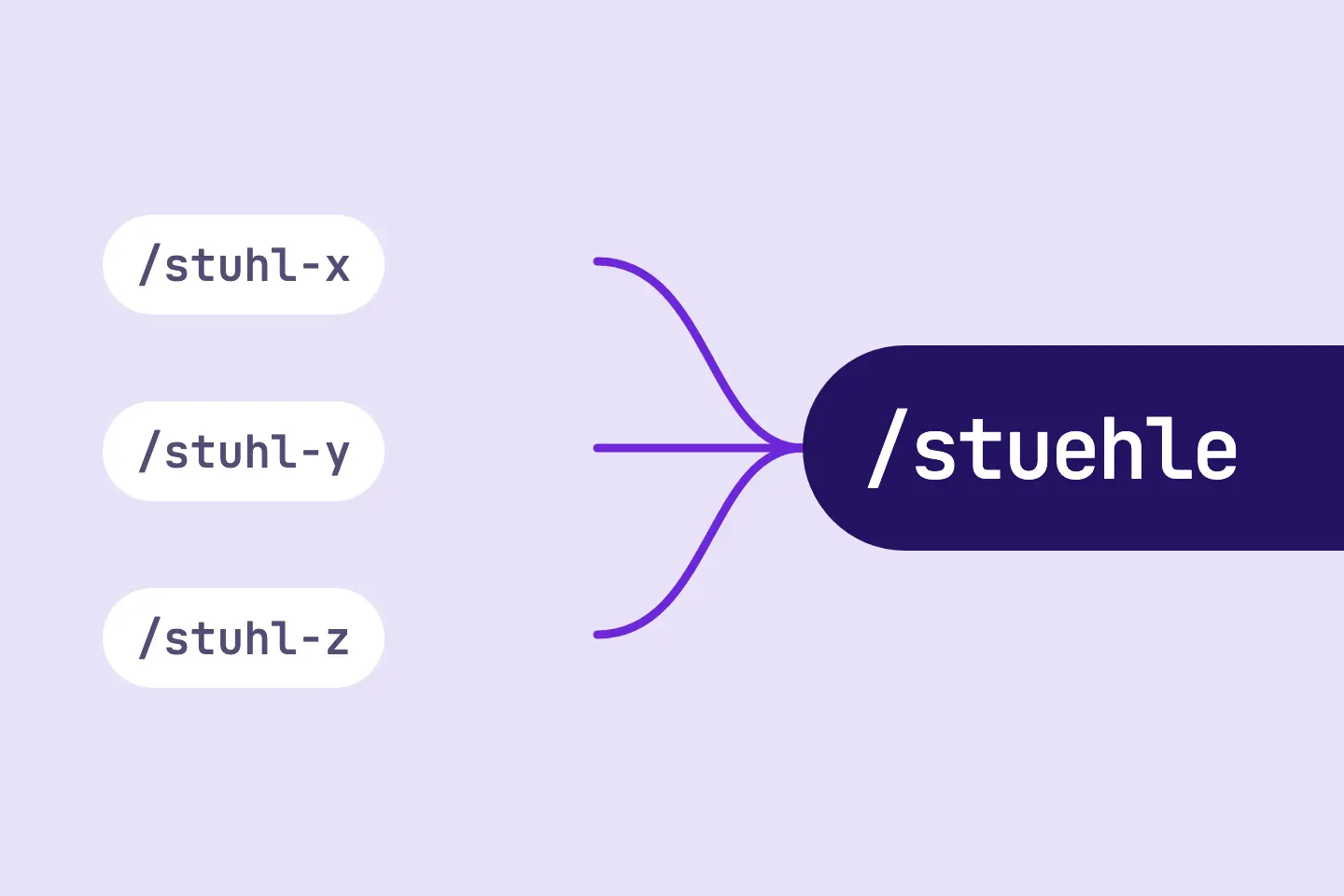
For each address you see the status, clicks, impressions and position in Google, and a suggestion for the successor page. RankScan first takes the parent page, for example /products/ for /products/chair-x/. If that is the home page or missing, RankScan looks for the page with the most similar title. If none fits, there is no suggestion. No suggestion is better than a bad one.
How to decide: 301 or 410 #
The rule of thumb: does someone who calls up the old address find what they are looking for on another page? If so, redirect there. If not, say clearly that the page no longer exists.
Step 1: Find a matching page #
Open the list «Deleted pages in Google» in the measure. For each address, check whether another page offers the same content. That can be a page that replaces or summarises the content, or a parent page on the same topic, such as the category instead of a single product.
Use the RankScan suggestion as a starting point. If it does not fit, choose a page yourself.
Step 2: 301 to the matching page #
If a matching page exists, have development or your agency set up a HTTP status 301 signals a permanent redirect: a URL has been permanently replaced by another. Search engines transfer the signals to the target URL.Open glossary entry →. Google treats a permanent redirect as a strong signal that the new page is the canonical one and passes on the signals of the old address. Visitors reach their goal instead of an error page.
Redirect straight to the final target, without intermediate hops. Google recommends keeping redirects in place as long as possible, generally at least one year.
Step 3: Never to the home page #
A redirect to the home page seems convenient. Google usually treats it as a soft 404: the old address has no successor, so the signals are lost anyway. Visitors are more confused than helped, because they do not find what they were looking for.
RankScan detects this case. If a deleted address redirects to the home page, it stays in the list with the note «redirects to the home page».
Step 4: Check backlinks, then 410 #
If no matching page exists, 410 «Gone» or 404 is the right answer. Google treats all 4XX status codes except 429 the same and drops the address from the index. A 410 also states clearly that the page was removed on purpose.
Before that, check under «Links» in Search Console whether other websites link to the address. RankScan does not see backlinks. If the page has valuable external links, it is worth looking for a page on a close topic for a 301.
Offer ways forward on the error page: a search, the main categories, a link to the home page. The server must still send status 404 or 410.
Step 5: Keep seasonal pages online #
If the content returns every year, such as an autumn promotion or an annual event, better not delete the page. Keep it online with a note, for example «The next promotion starts in September». The address then keeps its history in Google.
Step 6: Remove from Google faster (optional) #
If Google should stop showing the address quickly, use the «Removals» tool in Search Console. It hides the address for about six months. It only lasts if the page returns 404 or 410 during that time.
Step 7: Report the measure #
Publish the redirects and report the measure in RankScan as done.
How it is checked: The next full crawl checks every address in the list. An address drops out as soon as it redirects to a page other than the home page, as soon as it is online again (status 2XX) or as soon as its demand falls below the hint threshold. Because the time window covers 28 days, an address closes through the second route four weeks after the last click at the earliest. If the address returns 4XX and a page links to it again or it is back in the sitemap, RankScan reports a 4XX error instead.
What to settle before you delete a page #
The best redirect is the one you set up when you delete the page. This general checklist helps before deleting; RankScan only checks the points on the sitemap and Internal linking refers to links that connect pages within the same website. They control how search engines and users find and thematically classify content.Open glossary entry →.
- Demand: Does the page still bring visitors from Google? Then reworking it is often better than deleting it.
- Backlinks: Do other websites link to the page? Then look for a page on a close topic for the 301.
- Internal links and sitemap: Update links to the page and remove the address from the XML sitemap.
- Ads: Check whether the address is used as a final URL in campaigns. Otherwise ads lead nowhere or get rejected.
Common mistakes #
Mistake 1: Redirecting everything to the home page #
The most common mistake. Google usually treats it as a soft 404, and visitors do not find what they were looking for. Only redirect to pages on the same topic.
Mistake 2: Leaving a deleted page in the sitemap #
The sitemap tells Google which pages matter. A deleted address in it is a defect. RankScan reports it as a 4XX error. More on this in the article on the XML sitemap.
Mistake 3: Redirect chains #
If /old redirects to /between and that to /new, every hop costs time. Redirect straight to the target.
Mistake 4: Removing redirects after a few weeks #
Google and visitors need time until the new address has arrived everywhere. Keep redirects for at least one year.
Checklist: deleted pages #
- Checked for each address whether a matching page exists,
- set up 301s to matching pages, straight to the target, never to the home page,
- checked the links in Search Console before a 410,
- without a matching page: 410 or 404 with a helpful error page,
- kept seasonal pages online,
- optionally used the «Removals» tool,
- reported the measure as done in RankScan.
FAQ About deleted pages #
Does a 404 hurt my website?
No. Google itself says that a 404 is the right answer for removed content and does not hurt the rest of the website. Only a link to the missing page hurts, because it sends visitors nowhere.
Is 410 better than 404?
For Google it makes practically no difference: Google treats all 4XX status codes except 429 the same. A 410 states more clearly that the page was removed on purpose.
Why does RankScan show the page although I removed all links?
Because Google still shows it. RankScan also checks the addresses Google knows. That is exactly where visitors from search land.
Why is the measure only a hint?
Because no address reached 5 clicks and none had 100 impressions at an average position of 10 or better. A redirect is still worth it if a matching page exists.
Why don't I see the measure?
It needs a connected Google Search Console. Without it, RankScan does not know the demand in Google.
Conclusion: decide instead of redirecting on suspicion #
A deleted page that Google still shows is not a defect, but an open decision. If a matching page exists, a 301 takes visitors to their goal. If not, a 410 is the honest answer. The home page is never the right target.
Sources and further reading #
- Source: Google Search Central: Redirects and Google Search
- Source: Google Search Central: How HTTP status codes affect Google's crawlers
- Source: Google Search Central: Site moves and migrations
- Source: Search Console Help: Soft 404 errors
- Source: Search Console Help: 404 (Page Not Found) errors
- Source: Search Console Help: Removals tool
- Source: Google Search Central Blog: Do 404 errors hurt my site?