Wikidata is a free knowledge base run by the Wikimedia Foundation. It holds basic data about companies, people, places and products, in a form machines can read. Search engines and AI systems can use this data.
A Wikidata entry describes your company with name, website, headquarters and founding year. If it names your website as the official website, the match is unambiguous: this company belongs to this website.
In RankScan, the matching measure is called «Create a Wikidata entry for your company». It appears when Wikidata has no entry that names your website as the official website.
A Wikidata entry is a clean basic record, not a lever with a proven effect. There is no evidence that it increases AI mentions.
- The RankScan measure «Create a Wikidata entry for your company» appears when Wikidata has no entry with your website as official website (P856).
- Classification in RankScan: severity low · effort low · work type editorial.
- RankScan searches only via the website, never via the name. An entry with your company name but without your website counts as missing.
- If an entry already exists, you add the official website there. Otherwise you create a new one.
- Wikidata asks for evidence from serious, publicly available references. The commercial register backs data such as headquarters and founding date. For the company to count as notable, the Wikidata community also expects coverage in independent sources.
- If an agency edits the entry for pay, it must disclose this on its user page.
- Afterwards, your website links the entry in the Organization schema describes a company or organisation as an entity, with details such as name, URL, logo, address, contact and official profiles.Open glossary entry → under sameAs is a Schema.org property that links an entity to reference pages confirming its identity, such as official profiles, Wikipedia or Wikidata. It serves disambiguation.Open glossary entry →.
- How RankScan checks it: Mark the measure as done. In the next run, RankScan looks for a Wikidata entry with your website.
What Wikidata is and why companies are listed there #
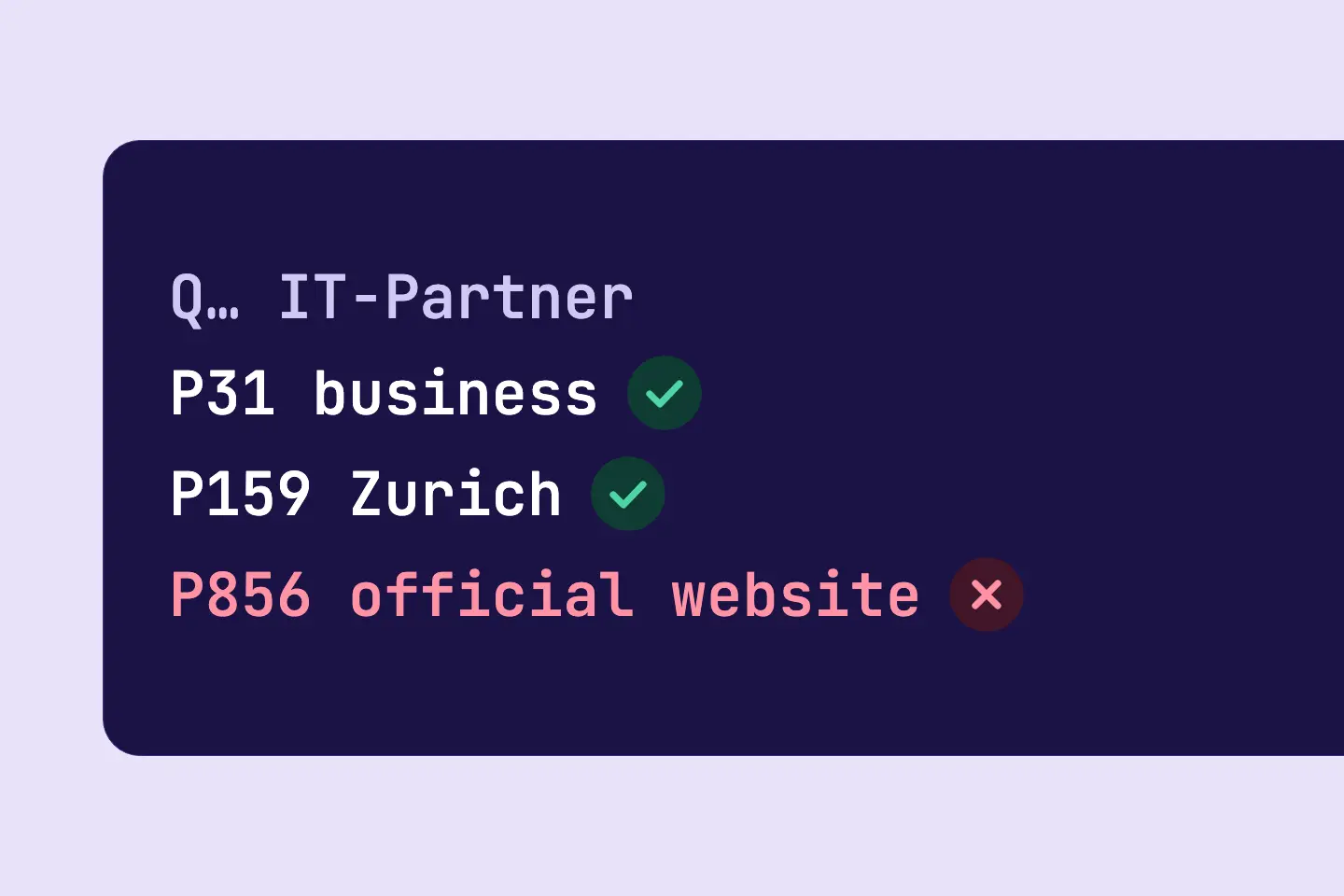
Wikidata collects facts as single statements. Each statement has a property and a value, for example «official website: https://example.com». Each entry has a fixed identifier that starts with «Q».
This is useful for a company because names are often ambiguous. Many companies have similar names. An identifier that points to your website resolves this ambiguity.
It also matters what RankScan does not claim. There is no evidence that an entry increases your mentions in AI answers or your rankings. The entry identifies your company unambiguously. RankScan promises no more than that.
More on An entity is a uniquely identifiable thing or concept, such as an organisation, person, brand, product, place or technical term. Search engines and AI systems process information as entities and their relationships.Open glossary entry → and why being unambiguous matters is in the article on entities and entity SEO.
What does «Create a Wikidata entry for your company» mean? #
Classification in RankScan: severity low · effort low · work type editorial.
At the end of a Health run, RankScan asks Wikidata whether an entry names your website as the official website. While the measure is open or reported, every Health run asks. Otherwise RankScan asks at most every 30 days. If RankScan finds none, the measure appears. It concerns the whole website, not single pages.
How RankScan searches #
RankScan searches via the property «official website» (P856), never via the name. It tries the usual spellings of your domain: with and without www, with https and http, with and without a trailing slash.
The entry counts as missing in these cases:
- The entry has no official website.
- It names an old domain.
- It names the website of the umbrella brand instead of your website.
- It names an address with a language path, such as
example.com/en.
Once the measure is closed, RankScan queries Wikidata again about every 30 days. If Wikidata deletes the entry, the next query opens the measure again.
What Wikidata requires #
Notability #
Wikidata accepts an entry if it refers to a clearly identifiable entity that can be described using serious and publicly available references. This is one of three criteria in Wikidata's notability policy.
For companies, the Wikidata community is strict. An essay on self-promotion states: a commercial register entry alone does not make a company notable. Independent coverage in reliable sources is also needed. Your own website, press releases and marketing material do not count.
The essay is not a binding policy. But it shows how many editors review company entries. An entry without an independent source can be deleted.
Suitable independent sources include:
- reports about your company in trade or local media,
- entries in association or industry directories with editorial review,
- awards or competitions with a public rationale.
References for single statements #
Every statement should have a reference. Wikidata attaches the reference directly to the statement. Common properties are:
- «stated in» (P248) for publications and databases,
- «reference URL» (P854) for a web page,
- «retrieved» (P813) for the date you read the web page.
For headquarters and founding date, the commercial register is a good reference. In Switzerland you find the entry via Zefix.
Conflict of interest and paid editing #
You may create the entry for your own company. The community discourages this and reviews such entries more closely. But an entry is not deleted because of who created it; it is deleted for missing references.
If an agency or an employee edits the entry for pay, a binding rule applies: they must disclose on their user page who pays them. Failing to do so can lead to a block.
How to create the Wikidata entry #
Step 1: Search for an existing entry #
Search wikidata.org for your company name. Also check former names and spellings.
If an entry exists, add the official website (P856) there. Check whether the entry names an old domain or the website of the umbrella brand. Enter your current website, without a language path.
Do not create a second entry if one already exists. Wikidata merges duplicates.
Step 2: Create a new entry #
If there is no entry, create one. An account is not required, but it makes your edits traceable.
Create a new item via the menu on the left and fill in:
- Label: the official name of your company,
- Description: a short, neutral phrase, such as «Swiss software company»,
- Aliases: other common names, if there are any.
Then add the first statements:
- «instance of» (P31): business (Q4830453),
- «official website» (P856): the start address of your domain without a path, such as
https://www.example.com.
Keep the description factual. Promotional words such as «leading» or «innovative» stand out negatively in reviews.
Step 3: Back the data with references #
Back the data with sources, for example the commercial register. Entries without sources often get deleted.
Attach a reference with «reference URL» and «retrieved» to every important statement. Add at least one independent source that reports on your company.
Step 4: Add headquarters, founding year, logo and profiles #
Add, as far as you can back them up:
- headquarters, on Wikidata «headquarters location» (P159): the place of your head office,
- founding year, on Wikidata «inception» (P571): the founding date,
- «logo image» (P154): your logo,
- profiles: for example your LinkedIn page via «LinkedIn company or organization ID» (P4264).
The logo must be a file on Wikimedia Commons. Commons only accepts files under a free licence. Upload the logo only if your company holds the rights and is willing to allow a free licence. Otherwise leave the logo out.
Step 5: Link the entry on your website #
Have your developers or agency link the entry under sameAs in the Organization markup of your website. The address has the form https://www.wikidata.org/wiki/Q… with the identifier of your entry.
This way both sides point to each other: the entry names your website, your website names the entry. How the Organization markup is built is in the article on entities and entity SEO.
Step 6: Mark the measure as done #
Mark the measure as done in RankScan.
How RankScan checks it: In the next run, RankScan looks for a Wikidata entry with your website. This also applies if the run does not reach every page. RankScan then reports «Fixed» or «Not fixed yet».
Common mistakes #
Mistake 1: Entry without an official website #
RankScan does not find an entry with name and description but without P856. For the measure, only the website counts.
Mistake 2: Entering the website with a language path #
example.com/de or example.com/en does not count as your website. Enter the domain without a path.
Mistake 3: Only the commercial register as a source #
The commercial register backs headquarters and founding date. Whether your company is notable on Wikidata, the community judges by independent sources. Without them, a deletion request is likely.
Mistake 4: Promotional text #
A description such as «leading provider of innovative solutions» reads like advertising. Describe factually what your company is.
Mistake 5: Not disclosing paid editing #
If an agency creates the entry for pay, it must disclose this. Otherwise it risks a block, and the entry comes under suspicion.
Checklist: Wikidata entry #
- searched for an existing entry, including former names,
- official website (P856) entered, without language path and without old domain,
- factual label and description,
- «instance of» business,
- references on the statements, at least one independent source,
- headquarters, founding year and profiles added, as far as referenced,
- paid editing disclosed,
- entry linked under
sameAsin the Organization markup, - measure marked as done in RankScan.
FAQ About the Wikidata Entry #
Why does RankScan show the measure although my company is on Wikidata?
RankScan searches only via the official website (P856). If the entry lacks it, or names an old domain, the umbrella brand or a language path, the entry counts as missing. Add your current website, and RankScan finds the entry in the next run.
Do I need a Wikipedia article for a Wikidata entry?
No. A Wikipedia article is only one of three routes to notability. An entry is also possible without Wikipedia if serious, publicly available references describe your company.
May I create the entry for my own company?
Yes. The community reviews such entries more closely, and you must disclose paid editing. What keeps the entry are the references.
Does a Wikidata entry raise my visibility in AI answers?
There is no evidence for that. The entry identifies your company unambiguously. Whether AI systems mention you depends on many other factors.
What happens if Wikidata deletes my entry?
RankScan queries Wikidata again about every 30 days. If RankScan no longer finds an entry, the measure opens again.
Conclusion: a referenced basic record #
A Wikidata entry takes little time once the references are at hand. It links your company unambiguously to your website. It is no guarantee of more AI mentions. What matters are independent sources, a factual description and the official website without detours.
Sources and further reading #
- Source: Wikidata: Notability
- Source: Wikidata: Self-promotion (essay)
- Source: Wikidata: Disclosure of paid editing
- Source: Wikidata: Help:Sources
- Source: Wikidata: Property P856, official website
- Source: Wikidata: Property P154, logo image
- Source: Wikidata: Property P31, instance of and Q4830453, business
- Source: Wikidata: Property P159, headquarters location
- Source: Wikidata: Property P571, inception
- Source: Wikidata: Property P4264, LinkedIn company or organization ID
- Source: Schema.org: sameAs
- Source: Zefix: Central Business Name Index of Switzerland